GMEOW Notation and Symbolic Systems Module
- IRI: https://blackcatinformatics.ca/gmeow/slices/notation
- Tier: core
Group: core
What This Slice Covers
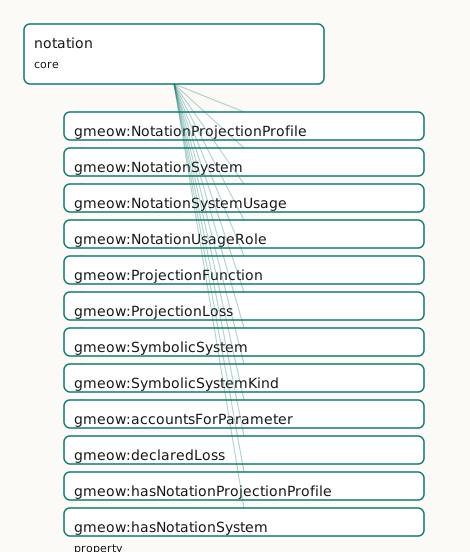
This slice owns 42 terms and contributes 7 mapping or projection rows. Use it when its terms match the native fact you want to preserve; use the linkage tables to see how those facts leave GMEOW for consumer vocabularies.
Dependencies
gmeow:slices/kernelgmeow:slices/languagegmeow:slices/observationsgmeow:slices/profilesgmeow:slices/temporal
Consumers
- Symbolic/notation systems for the language family and the music slice's lossy notation projections.
Local Map
Examples
Notation Systems
- Source:
slices/core/notation/examples/notation-systems.ttl - GMEOW terms:
gmeow:NotationSystem,gmeow:WritingSystem,gmeow:langEnglish,gmeow:notationSystemFor,gmeow:notationSystemKind,gmeow:symbolicKindEncoding,gmeow:symbolicKindMusical,gmeow:symbolicKindTranscription,gmeow:writingSystemAsNotation
# SPDX-FileCopyrightText: 2026 Blackcat Informatics® Inc. <paudley@blackcatinformatics.ca>
# SPDX-License-Identifier: CC-BY-4.0
#
# Worked example: notation systems, one machinery for every symbol set . A
# gmeow:NotationSystem is classified by an open gmeow:notationSystemKind
# (musical / mathematical / transcription / encoding / stenographic …), so staff
# notation, IPA, Morse and a math syntax are the SAME kind of object — a symbolic
# system for representing something. A transcription notation declares which
# language it transcribes (gmeow:notationSystemFor); a script is itself a notation
# system, reached from the writing system via gmeow:writingSystemAsNotation.
@prefix gmeow: <https://blackcatinformatics.ca/gmeow/> .
@prefix ex:    <https://blackcatinformatics.ca/gmeow/examples/notation/> .
@prefix rdfs:  <http://www.w3.org/2000/01/rdf-schema#> .

# --- Western staff notation: a musical symbolic system, not tied to a language.
ex:staffNotation a gmeow:NotationSystem ;
    rdfs:label              "Western staff notation"@en ;
    gmeow:notationSystemKind gmeow:symbolicKindMusical .

# --- The IPA: a transcription system FOR a language (here English).
ex:ipa a gmeow:NotationSystem ;
    rdfs:label               "International Phonetic Alphabet"@en ;
    gmeow:notationSystemFor  gmeow:langEnglish ;
    gmeow:notationSystemKind gmeow:symbolicKindTranscription .

# --- A script IS a notation system: the Latin writing system, viewed as the
#     encoding notation it provides.
ex:latin a gmeow:WritingSystem ;
    rdfs:label                  "Latin script"@en ;
    gmeow:writingSystemAsNotation ex:latinNotation .

ex:latinNotation a gmeow:NotationSystem ;
    rdfs:label               "Latin-script encoding"@en ;
    gmeow:notationSystemKind gmeow:symbolicKindEncoding .
Terms
Classes
| Term | Label | Definition |
|---|---|---|
gmeow:NotationProjectionProfile |
Notation Projection Profile | A closed descriptor schema for the lossy projection from frame-relative content to one notation system. Declares representable parameters, incurred losses, and... |
gmeow:NotationSystem |
Notation System | A structured symbolic system with defined rules for representing information in a specific domain — mathematical notation, musical notation, stenography, phone... |
gmeow:NotationSystemUsage |
Notation System Usage | A reified, role- and period-scoped use of a notation system by an entity — an observation in the universal claim stack (observation-spine bridge): the gufo:Rel... |
gmeow:NotationUsageRole |
Notation Usage Role | The role a notation system plays in a specific usage — a value, never an Entity subclass. Open-ended: new analytical frameworks may introduce further roles wit... |
gmeow:ProjectionFunction |
Projection Function | An FnO function that renders canonical frame-relative content to a notation system (Principle 12). |
gmeow:ProjectionLoss |
Projection Loss | A kind of information loss incurred when canonical content is projected to a notation system. An open value vocabulary of individuals; never subclassed (Princi... |
gmeow:SymbolicSystem |
Symbolic System | A system of symbols, signs, or conventions used for communication, representation, or expression. Broad umbrella covering notation systems, gesture systems, em... |
gmeow:SymbolicSystemKind |
Symbolic System Kind | The domain or kind of a symbolic or notation system — a value, never an Entity subclass. The seed list is an anchor, not a fence; new domains may introduce fur... |
Properties
| Term | Label | Definition |
|---|---|---|
gmeow:accountsForParameter |
accounts for parameter | The parameter whose omission or approximation is explained by this ProjectionLoss. Used by completeness gates to ensure every parameter is representable or acc... |
gmeow:declaredLoss |
declared loss | A loss that this notation system incurs when rendering canonical frame-relative content (e.g. quantization to 12-EDO, dropping microtiming). |
gmeow:hasNotationProjectionProfile |
has notation projection profile | Links a notation system to its GMEOW projection profile. Non-functional: a future notation system may have co-existing profiles for different consumer contexts. |
gmeow:hasNotationSystem |
has notation system | A notation system used by a language — e.g. IPA for phonetic transcription, a stenographic system for shorthand. NON-FUNCTIONAL: a language may use many notati... |
gmeow:notationSystemFor |
notation system for | The language(s) a notation system is used for or parasitic on. NON-FUNCTIONAL: a notation may serve multiple languages (e.g. IPA), and domain-specific notation... |
gmeow:notationSystemKind |
notation system kind | The kind(s) of a notation system (gmeow:SymbolicSystemKind values). Subproperty of symbolicSystemKind for convenience; non-functional. |
gmeow:notationSystemOf |
notation system of | The notation system that this projection profile describes. Functional: one notation system per projection profile. |
gmeow:notationUsageInterval |
notation usage interval | The time interval over which the notation usage is asserted to hold. Functional per relator: one interval per NotationSystemUsage. |
gmeow:notationUsageNotationSystem |
notation usage notation system | The notation system being used. Functional per relator: one notation system per NotationSystemUsage. |
gmeow:notationUsageRole |
notation usage role | The role the notation plays in this usage — transcription, encoding, representation, communication, expression, shorthand, cipher. Functional per relator: one... |
gmeow:notationUsageTarget |
notation usage target | The entity that uses the notation system — a language, lexical form, expression, work, or information object. Functional per relator: one target per NotationSy... |
gmeow:projectableExpression |
projectable expression | A solver-bound input property: the entity being projected through a NotationProjectionProfile. Used by FnO projection functions to declare their input type; no... |
gmeow:projectionFunction |
projection function | An FnO function reference that renders canonical content to this notation system (Principle 12). |
gmeow:representableParameter |
representable parameter | A parameter that this notation system can represent without loss (e.g. pitch in a 12-EDO-aware staff notation). Range is kept open in the core framework; domai... |
gmeow:smuflCodepoint |
SMuFL codepoint | A Unicode codepoint reference in the Standard Music Font Layout (SMuFL) specification that identifies a glyph used by this notation system. Multiple codepoints... |
gmeow:symbolicSystemKind |
symbolic system kind | The kind(s) of a symbolic system (gmeow:SymbolicSystemKind values). Non-functional — a system may serve multiple domains simultaneously. |
gmeow:writingSystemAsNotation |
writing system as notation | When a writing system is also a notation system — e.g. Braille as a tactile notation, or a bespoke conlang script that doubles as a featural notation. NON-FUNC... |
Individuals
| Term | Label | Definition |
|---|---|---|
gmeow:notationRoleCipher |
cipher | Using a notation to conceal or encrypt information. |
gmeow:notationRoleCommunication |
communication | Using a notation as a medium of communication between agents. |
gmeow:notationRoleEncoding |
encoding | Using a notation to map information into a different representation or signal system. |
gmeow:notationRoleExpression |
expression | Using a notation for artistic, emotional, or creative expression. |
gmeow:notationRoleRepresentation |
representation | Using a notation to represent domain-specific objects, relations, or structures. |
gmeow:notationRoleShorthand |
shorthand | Using a notation for abbreviated or rapid recording of language or information. |
gmeow:notationRoleTranscription |
transcription | Using a notation to record spoken or signed language in a structured form. |
gmeow:symbolicKindCommunicationConvention |
communication convention | A broad social or cultural convention for communication that does not rise to the level of a full language or notation system. |
gmeow:symbolicKindCryptographic |
cryptographic | A transform scheme for concealing or securing information through encryption or encoding. |
gmeow:symbolicKindEmoji |
emoji | A convention-based system of pictographic symbols used in digital communication. |
gmeow:symbolicKindEncoding |
encoding | A scheme for mapping information from one representation to another. |
gmeow:symbolicKindGesture |
gesture | A system of physical gestures or movements used for communication or expression. |
gmeow:symbolicKindMathematical |
mathematical | A notation system for representing mathematical objects, relations, and proofs. |
gmeow:symbolicKindMusical |
musical | A notation system for representing musical structure, performance, or sound. |
gmeow:symbolicKindPlatformConvention |
platform convention | A symbol or communication convention specific to a platform, community, or digital environment. |
gmeow:symbolicKindStenographic |
stenographic | A shorthand notation system for rapid recording of spoken language. |
gmeow:symbolicKindTranscription |
transcription | A notation system for recording spoken or signed language in a structured visual form. |
Linkages
- Rows: 7
- Projection profiles: -
- External vocabularies:
schema,wd
| Source | Kind | Profile | Predicate/Relation | Target | Evidence |
|---|---|---|---|---|---|
gmeow:NotationSystem |
equivalence | - |
skos:relatedMatch | wd:Q2001982 | gmeow-notation.sssom.tsv; gmeow:eqNotation003; confidence 0.6 |
gmeow:SymbolicSystem |
equivalence | - |
skos:relatedMatch | schema:DefinedTermSet | gmeow-notation.sssom.tsv; gmeow:eqNotation001; confidence 0.5 |
gmeow:SymbolicSystem |
equivalence | - |
skos:relatedMatch | wd:Q80071 | gmeow-notation.sssom.tsv; gmeow:eqNotation002; confidence 0.5 |
gmeow:symbolicKindCryptographic |
equivalence | - |
skos:closeMatch | wd:Q8789 | gmeow-notation.sssom.tsv; gmeow:eqNotation008; confidence 0.7 |
gmeow:symbolicKindMathematical |
equivalence | - |
skos:closeMatch | wd:Q1140046 | gmeow-notation.sssom.tsv; gmeow:eqNotation005; confidence 0.8 |
gmeow:symbolicKindMusical |
equivalence | - |
skos:closeMatch | wd:Q233861 | gmeow-notation.sssom.tsv; gmeow:eqNotation006; confidence 0.8 |
gmeow:symbolicKindStenographic |
equivalence | - |
skos:closeMatch | wd:Q181066 | gmeow-notation.sssom.tsv; gmeow:eqNotation007; confidence 0.8 |
Guide
Notation and Symbolic Systems — modelling & interoperability guide
Most vocabularies conflate symbol systems with languages: a musical score is "in English", mathematical notation is "a language", emoji are "characters in a language". GMEOW rejects this collapse. A symbol system is not a language by default; it becomes one only through a standpointed claim (Principle 9).
Governing tenet: neutral symbolic systems
A gmeow:SymbolicSystem is a first-class InformationObject — a system of
symbols, signs, or conventions used for communication, representation, or
expression. It sits alongside Language and WritingSystem as a sibling under
InformationObject, not as a subclass of either.
A gmeow:NotationSystem is a structured symbolic system with defined rules
for representing information in a specific domain. It is a SubKind of
SymbolicSystem.
Why the sibling approach? Making WritingSystem a subclass of
NotationSystem would force all writing systems to carry notation-specific
properties (domain, encoding scheme) and all notation systems to carry
writing-system properties (ISO 15924 code, text direction). The sibling
approach keeps each class minimal and lets explicit bridging properties
(hasNotationSystem, writingSystemAsNotation) do the linking.
The boundary: language vs notation vs symbolic system
| Criterion | Language |
NotationSystem |
SymbolicSystem |
|---|---|---|---|
| Generative syntax/semantics | Yes (independent) | No (parasitic or domain-bound) | No (convention-based) |
| Parseable serialization | Often | Sometimes (as encoding) | Rarely |
| Human native speakers | May have | Never | Never |
| Domain specificity | General communication | Specific domain (math, music, crypto) | Any convention |
| Structured rules | Grammar | Representation rules | Social/platform conventions |
Decision table
| System | GMEOW classification | Rationale |
|---|---|---|
| IPA | NotationSystem (transcription) |
Phonetic representation of spoken language; parasitic, not generative |
| Morse code | NotationSystem (encoding) |
Signal encoding of text; no independent syntax/semantics |
| Stenography | NotationSystem (shorthand) |
Speed-writing system for a specific language |
| Cipher systems | NotationSystem (cryptographic) |
Transform scheme; not a language unless standpointed |
| Emoji conventions | SymbolicSystem (communication) |
Convention-based symbols without generative syntax |
| Mathematical notation | NotationSystem (mathematical) |
Domain-specific representational rules |
| TeX / LaTeX | FormalLanguage |
Grammar-defined with parseable syntax and semantics |
| MathML | FormalLanguage |
XML grammar with defined semantics |
| MusicXML / MEI | FormalLanguage or NotationSystem |
Grammar-defined encoding; also musical notation — co-modelable via standpoint |
| MIDI | FormalLanguage or NotationSystem |
Protocol with defined structure; also encoding — co-modelable via standpoint |
| ABC notation | FormalLanguage or NotationSystem |
Text-based music notation with grammar — co-modelable via standpoint |
| LilyPond | FormalLanguage or NotationSystem |
Programming language for music engraving; also music notation — co-modelable via standpoint |
Boundary rules
-
Stenography is usually a notation system for an existing language. It has no independent generative syntax; it encodes an existing language in abbreviated form.
-
Cryptographic ciphers / encodings are not languages by default. They are transform schemes. A standpoint may claim a cipher as a language (e.g. a conlang built on cipher principles), but the default classification is
NotationSystem. -
IPA and Morse code are notation / transcription / encoding systems, not natural languages. They lack independent syntax and semantics.
-
TeX, MathML, OpenMath, MusicXML, MEI, MIDI, LilyPond, and ABC notation may be
FormalLanguageinstances when treated as grammar-defined encodings. They have parseable syntax and defined semantics. They may ALSO be modeled asNotationSystemvia co-modeling — a single entity can carry both classifications from different standpoints (Principle 9). -
Emoji, gesture, meme, and platform conventions are notation or communication conventions unless modeled as full languages by a standpointed claim. They lack generative syntax and are convention-based.
Usage pattern: NotationSystemUsage
The reified relator NotationSystemUsage binds an entity to a notation system
with a role and interval, mirroring WritingSystemUsage:
@prefix gmeow: <https://blackcatinformatics.ca/gmeow/> .
@prefix ex:    <https://example.org/notation/> .

ex:english a gmeow:Language .

ex:ipa a gmeow:NotationSystem ;
    gmeow:notationSystemKind gmeow:symbolicKindTranscription .

ex:englishUsesIpa a gmeow:NotationSystemUsage ;
    gmeow:notationUsageTarget ex:english ;
    gmeow:notationUsageNotationSystem ex:ipa ;
    gmeow:notationUsageRole gmeow:notationRoleTranscription ;
    gmeow:notationUsageInterval ex:ipaUsageInterval .
A musical work using staff notation:
ex:beethoven9 a gmeow:CreativeWork .

ex:staffNotation a gmeow:NotationSystem ;
    gmeow:notationSystemKind gmeow:symbolicKindMusical .

ex:beethoven9UsesStaff a gmeow:NotationSystemUsage ;
    gmeow:notationUsageTarget ex:beethoven9 ;
    gmeow:notationUsageNotationSystem ex:staffNotation ;
    gmeow:notationUsageRole gmeow:notationRoleRepresentation ;
    gmeow:notationUsageInterval ex:staffUsageInterval .
Co-modeling: when a system is both language and notation
A system may be classified as both a FormalLanguage and a NotationSystem
from different standpoints. GMEOW handles this through co-equal,
standpoint-indexed claims (Principle 9), not subclass overlap:
ex:musicxml a gmeow:InformationObject .

# Standpoint A: MusicXML is a formal language (grammar-defined XML)
ex:claimA a gmeow:StandpointClaim ;
    gmeow:vantage ex:softwareEngineer ;
    gmeow:observedFeature ex:musicxml ;
    gmeow:observationResult gmeow:originFormal .

# Standpoint B: MusicXML is a musical notation system
ex:claimB a gmeow:StandpointClaim ;
    gmeow:vantage ex:musicLibrarian ;
    gmeow:observedFeature ex:musicxml ;
    gmeow:observationResult gmeow:symbolicKindMusical .
Projections and lossy drops
| Target vocabulary | What maps | What's dropped |
|---|---|---|
| SKOS | SymbolicSystem → skos:ConceptScheme; NotationSystem → skos:ConceptScheme |
Domain specificity, usage roles, temporal scope |
| schema.org | SymbolicSystem → schema:DefinedTermSet |
Structured rules, reified usage |
| MathML / OpenMath | NotationSystem (mathematical) → math element container |
Notation metadata, standpoint, temporal scope |
| MusicXML / MEI | NotationSystem (musical) → score container |
Usage relator, confidence, standpoint |
| MIDI | NotationSystem (musical) → track/sequence |
Human-readable notation semantics |
Projection framework: NotationProjectionProfile
A gmeow:NotationProjectionProfile is a gmeow:Profile (from the core
profiles slice) that describes how a NotationSystem projects canonical,
frame-relative content. It is deliberately not the canonical content itself;
it is a machine-readable, honest declaration of what survives the projection
and what is lost (Principles 4, 11, 12).
Every profile states:
gmeow:notationSystemOf— exactly oneNotationSystembeing described.gmeow:representableParameter— parameters the notation can carry without loss (range is open in core; domain slices constrain it, e.g. toMusicalParameterin the music extension).gmeow:declaredLoss—ProjectionLossindividuals that explain what the notation drops or approximates.gmeow:projectionFunction— an FnO function reference that performs the render.
A gmeow:ProjectionLoss is an abstract individual type (value vocabulary;
never subclassed). Each loss may gmeow:accountsForParameter one or more
parameters so that completeness gates can prove every parameter is either
represented or explicitly accounted for.
The core framework intentionally stays domain-agnostic. The music extension
provides the concrete MusicalParameter vocabulary, music-domain
NotationSystem individuals, and per-system projection profiles.
Terms
gmeow:SymbolicSystem · gmeow:NotationSystem · gmeow:SymbolicSystemKind · gmeow:symbolicSystemKind · gmeow:notationSystemKind
A SymbolicSystem is a first-class InformationObject — a convention-based
system of symbols — sitting alongside Language and WritingSystem as a
sibling, never a subclass. A NotationSystem is a structured SubKind of it
with defined representation rules in a specific domain. SymbolicSystemKind
values classify each via symbolicSystemKind / notationSystemKind
(transcription, encoding, musical, mathematical, …).
gmeow:hasNotationSystem · gmeow:notationSystemFor · gmeow:writingSystemAsNotation
The explicit bridging properties that do the linking the sibling design keeps
out of the class hierarchy: relating an entity to a notation system it uses, its
inverse, and the bridge that views a WritingSystem as a NotationSystem.
gmeow:NotationSystemUsage · gmeow:NotationUsageRole · gmeow:notationUsageTarget · gmeow:notationUsageNotationSystem · gmeow:notationUsageRole · gmeow:notationUsageInterval
The reified relator binding an entity to a notation system with a role and an
interval, mirroring WritingSystemUsage: notationUsageTarget the entity,
notationUsageNotationSystem the system, notationUsageRole a NotationUsageRole
value (transcription, representation, …), and notationUsageInterval the span it
held.
gmeow:NotationProjectionProfile · gmeow:hasNotationProjectionProfile · gmeow:notationSystemOf · gmeow:representableParameter · gmeow:projectableExpression
A Profile (from the core profiles slice) declaring how a NotationSystem
projects canonical, frame-relative content — honestly, not the canonical content
itself. notationSystemOf names the one system described,
representableParameter the parameters it carries without loss, and
projectableExpression the expressions it can render; hasNotationProjectionProfile
attaches it.
gmeow:ProjectionLoss · gmeow:declaredLoss · gmeow:accountsForParameter · gmeow:ProjectionFunction · gmeow:projectionFunction
A ProjectionLoss is an abstract value individual (never subclassed) explaining
what a notation drops or approximates; declaredLoss lists them on a profile and
accountsForParameter ties each to the parameters it covers so completeness gates
can prove every parameter is represented or accounted for. A ProjectionFunction
referenced by projectionFunction is the FnO function that performs the render.
gmeow:smuflCodepoint
A Unicode codepoint reference in the Standard Music Font Layout (SMuFL)
specification identifying a glyph used by a NotationSystem; multiple codepoints
may be asserted as multiple triples.