GMEOW Core Module
- IRI: https://blackcatinformatics.ca/gmeow/slices/kernel
- Tier: core
Group: core
What This Slice Covers
This slice owns 77 terms and contributes 78 mapping or projection rows. Use it when its terms match the native fact you want to preserve; use the linkage tables to see how those facts leave GMEOW for consumer vocabularies.
Consumers
- Every slice: the gUFO-grounded kernel (
Entity,Agent,InformationObject, base relations).
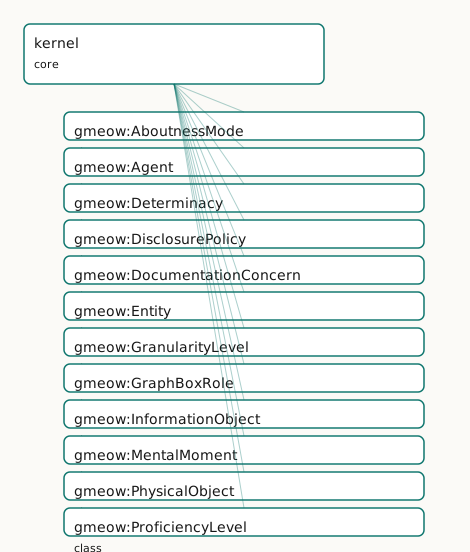
Local Map
Examples
Sensitivity And Disclosure
- Source:
slices/core/kernel/examples/sensitivity-and-disclosure.ttl - GMEOW terms:
gmeow:InformationObject,gmeow:consumerInternalArchive,gmeow:consumerPublicSite,gmeow:determinacyCrisp,gmeow:eligibleForConsumer,gmeow:hasDeterminacy,gmeow:hasDisclosurePolicy,gmeow:hasPart,gmeow:hasSensitivity,gmeow:partOf
# SPDX-FileCopyrightText: 2026 Blackcat Informatics® Inc. <paudley@blackcatinformatics.ca>
# SPDX-License-Identifier: CC-BY-4.0
#
# Worked example: the kernel disclosure machinery (Principles 10 and 12). Any entity can
# declare HOW SENSITIVE it is (gmeow:hasSensitivity), the POLICY governing its
# release (gmeow:hasDisclosurePolicy), and WHICH CONSUMERS are eligible to receive
# it (gmeow:eligibleForConsumer → a ProjectionContext). This is the projection/
# disclosure boundary: a confidential record is never deleted, only withheld from
# the wrong consumer (P10 suppression, P12 solver/presentation split). Part-whole
# mereology (gmeow:partOf / gmeow:hasPart) and gmeow:hasDeterminacy (how crisp the
# value is) are the other kernel primitives every slice reuses.
@prefix gmeow: <https://blackcatinformatics.ca/gmeow/> .
@prefix ex:    <https://blackcatinformatics.ca/gmeow/examples/kernel/> .
@prefix rdfs:  <http://www.w3.org/2000/01/rdf-schema#> .

# --- A dossier composed of records (part-whole).
ex:dossier a gmeow:InformationObject ;
    rdfs:label    "Personnel dossier — Dana Reyes"@en ;
    gmeow:hasPart ex:salaryRecord , ex:bioNote .

# --- A confidential record: sensitive, internal-only, eligible only for the
#     internal archive — withheld from public consumers, not deleted.
ex:salaryRecord a gmeow:InformationObject ;
    rdfs:label                "Compensation record"@en ;
    gmeow:partOf              ex:dossier ;
    gmeow:hasSensitivity      gmeow:sensitivityConfidential ;
    gmeow:hasDisclosurePolicy gmeow:policyInternalOnly ;
    gmeow:eligibleForConsumer gmeow:consumerInternalArchive ;
    gmeow:hasDeterminacy      gmeow:determinacyCrisp .

# --- A public-safe record in the same dossier: same container, different
#     disclosure — eligibility is per-record, not per-dossier.
ex:bioNote a gmeow:InformationObject ;
    rdfs:label                "Public bio note"@en ;
    gmeow:partOf              ex:dossier ;
    gmeow:hasSensitivity      gmeow:sensitivityPublic ;
    gmeow:hasDisclosurePolicy gmeow:policyPublicSafe ;
    gmeow:eligibleForConsumer gmeow:consumerPublicSite ;
    gmeow:hasDeterminacy      gmeow:determinacyCrisp .
Terms
Classes
| Term | Label | Definition |
|---|---|---|
gmeow:AboutnessMode |
Aboutness Mode | The rhetorical relation between an information carrier and its subject matter — whether the carrier describes the subject (mention: reporting, quoting, depicti... |
gmeow:Agent |
Agent | An entity that can act, bear responsibility, and enter into agreements: a person, an organization, or a software agent. |
gmeow:Determinacy |
Determinacy | The model of ontic determinacy or indeterminacy for a value — whether it is inherently crisp, vague, fuzzy, probabilistic, or disputed. Distinct from epistemic... |
gmeow:DisclosurePolicy |
Disclosure Policy | The disclosure posture of a value or claim — an open value vocabulary of individuals (never subclasses) classifying whether and under what conditions the fact... |
gmeow:DocumentationConcern |
Documentation Concern | A cross-cutting documentation theme generated into its own guide page. Terms opt into a concern with gmeow:docsConcern so adoption-oriented docs are ontology-b... |
gmeow:Entity |
Entity | Anything in the GMEOW universe of discourse that persists in time and can bear properties: an agent, a document, a contact point, and so on. |
gmeow:GranularityLevel |
Granularity Level | A level of detail / resolution at which a value is expressed — a point on an open, ordered, domain-general axis (spatial: point ≺ address ≺ city ≺ region ≺ cou... |
gmeow:InformationObject |
Information Object | An entity whose nature is to carry information content: a document, dataset, software artifact, online account, or message. The shared parent of the document,... |
gmeow:MentalMoment |
Mental Moment | The umbrella category of all agent mental states — intrinsic modes inhering in exactly one agent that constitute its cognitive / doxastic / conative life: know... |
gmeow:PhysicalObject |
Physical Object | An entity that is a material thing occupying space and time — a device, instrument, vehicle, building, or natural body. Distinct from Agent (which acts and bea... |
gmeow:ProficiencyLevel |
Proficiency Level | An attained proficiency level on a gmeow:ProficiencyScale (CEFR A1–C2; Dreyfus novice→expert; NIH beginner→expert; assessed; native; heritage). Carried by gmeo... |
gmeow:ProficiencyModality |
Proficiency Modality | The channel a proficiency rates (speaking, listening, reading, writing, signing, comprehension, overall). A value carried by gmeow:proficiencyModality. |
gmeow:ProficiencyScale |
Proficiency Scale | A framework for rating proficiency in any competency domain — language, skill, or knowledge (CEFR, ILR, ACTFL, Dreyfus, NIH, Bloom's, SOLO, assessed, self-repo... |
gmeow:ProjectionContext |
Projection Context | The consumer or audience for which a fact is eligible to be projected — an open value vocabulary of individuals (never subclasses). Names downstream targets su... |
gmeow:SensitivityLevel |
Sensitivity Level | A privacy-sensitivity classification for a value — an open, ordered value vocabulary (public ≺ internal ≺ confidential ≺ restricted ≺ sensitive personal). The... |
gmeow:SocialObject |
Social Object | An entity that exists by virtue of social convention, collective acceptance, or sustained narrative practice — a myth, an urban legend, an agreement, a standpo... |
Properties
| Term | Label | Definition |
|---|---|---|
gmeow:avoidForConsumer |
avoid for consumer | Term-level advisory metadata naming downstream ProjectionContext individuals for which the annotated ontology construct is normally too detailed, too lossy, or... |
gmeow:avoidWhen |
avoid when | Term-level advisory metadata naming conditions in which a class, property, individual, or slice-level construct should not be used, or should be promoted to a... |
gmeow:coarsenGuarded |
coarsen guarded | Marks a property as PRECISION-BEARING for disclosure control (precision guard, CONSTITUTION P10): when a projection branch reads this property of a subject, th... |
gmeow:coarsenTo |
coarsen to | Disclosure control: marks a value/relator so that at projection time it is generalized to no finer than the named gmeow:GranularityLevel — a coarser ancestor i... |
gmeow:coarserThan |
coarser than | Orders the granularity axis: relates a granularity level to a finer level it generalizes (country gmeow:coarserThan city). Transitive; the partial order that m... |
gmeow:coequalFacet |
co-equal facet | Marks a property as one co-equal identity-facet axis among peers (CONSTITUTION P9, co-equal facet lint). Every property annotated coequalFacet true is held ort... |
gmeow:connectsTo |
connects to | Universal traversable-link relation: relates any GMEOW thing to another thing it is directly connected to in a graph, network, or path. Intentionally broad; us... |
gmeow:docsConcern |
documentation concern link | Links a term, slice, or documentation-bearing resource to a gmeow:DocumentationConcern. Used only by documentation projections; it carries no logical semantics... |
gmeow:eligibleForConsumer |
eligible for consumer | Relates a value, entity, or claim to the projection consumers it is eligible for — the explicit who facet of disclosure control. Domain-free (universal, like... |
gmeow:frameCardinality |
frame cardinality | Optional cardinality override for a gmeow:requiresFrame declaration: "exactly-one" or "at-least-one". Absent, the cardinality is derived from the frame propert... |
gmeow:frameRequirementSeverity |
frame requirement severity | Optional severity for a gmeow:requiresFrame declaration: "warning" downgrades the generated frame-relativity shape from sh:Violation to sh:Warning (used while... |
gmeow:generalizesVia |
generalizes via | Projection-compiler guidance naming the transitive part/whole property to walk when coarsening a value (e.g. gmeow:containedInPlace for places). Defaults to gm... |
gmeow:guideBlob |
guide blob | Links a slice to the content-addressed digest of its Tier-2 narrative guide as embedded in a GTS package: the guide rides the same file as the ontology, sub-pr... |
gmeow:hasAboutness |
has aboutness | Relates an information carrier (a document, span, segment, citation act, exemplar, or statement via the statement layer) to its aboutness mode — the explicit f... |
gmeow:hasDeterminacy |
has determinacy | Relates a value, entity, or claim to its ontic determinacy model — the explicit facet recording whether the value is crisp, vague, fuzzy, probabilistic, or dis... |
gmeow:hasDisclosurePolicy |
has disclosure policy | Relates a value, entity, or claim to its disclosure policy — the explicit what facet of disclosure control. Domain-free (universal, like hasGranularity and h... |
gmeow:hasGranularity |
has granularity | Relates a value, place, period, coordinate or measurement to its own resolution level — the explicit 'no silent precision' facet, queryable independently of an... |
gmeow:hasPart |
has part | Universal whole-to-part inverse of gmeow:partOf. Transitive and intentionally broad; specialized component and containment properties remain the authoritative... |
gmeow:hasSensitivity |
has sensitivity | Relates a value, entity, or claim to its privacy-sensitivity level — the explicit facet that drives disclosure-control decisions (coarsenTo / displayable) at p... |
gmeow:hasUnit |
has unit | Relates a quantitative value or measurement to its QUDT unit (by reference, never imported). Domain-free: used by temporal measurements, spatial measurements,... |
gmeow:howToUse |
how to use | Term-level advisory metadata carrying a short modeling recipe for the HOW facet: the companion properties, relators, statement metadata, or projection checks t... |
gmeow:namingNote |
naming note | An explicit justification for a term local name that the primary/preferred/default/main naming lint (CONSTITUTION P9, co-equal facet lint) would otherwise reje... |
gmeow:pairsWith |
pairs with | Links the two halves of a flat-first/reify-on-demand pair — the flat shortcut and the reified relator that carries the same relationship when period, role, con... |
gmeow:partOf |
part of | Universal part-to-whole relation: relates any GMEOW thing to a larger whole it is part of. Transitive and intentionally broad; use specialized subproperties su... |
gmeow:requiresFrame |
requires frame | Declares that every instance of the annotated class must carry the named reference-frame property (CONSTITUTION P11, frame-relativity gate): 'a value asserted... |
gmeow:useForConsumer |
use for consumer | Term-level advisory metadata naming downstream ProjectionContext individuals for which the annotated ontology construct is normally appropriate. This is docume... |
gmeow:useWhen |
use when | Term-level advisory metadata naming the modeling situation in which a class, property, individual, or slice-level construct should be used. A narrower, machine... |
Individuals
| Term | Label | Definition |
|---|---|---|
gmeow:aboutnessDescribes |
describes | The describing (mention) aboutness mode — the carrier reports, quotes, depicts, defines, or analyzes its subject without performing it. Source material about a... |
gmeow:aboutnessEnacts |
enacts | The enacting (use) aboutness mode — the carrier performs, demands, exemplifies, or embodies its subject rather than merely reporting it. A style guide whose pr... |
gmeow:concernDisclosure |
disclosure and suppression | Projection-time withholding, coarsening, sensitivity, and display control. |
gmeow:concernFrames |
frames and units | Reference frames, units, determinacy, granularity, and frame-relative values. |
gmeow:concernGTSPackaging |
GTS packaging | The single-file Graph Transport Substrate and bundled documentation distribution. |
gmeow:concernIdentifiersCoreference |
identifiers and coreference | External authority links, identifier records, and reference-only bridging. |
gmeow:concernProvenanceEvidence |
provenance and evidence | Attribution, derivation, confidence, evidence, and source lineage. |
gmeow:concernStandpoints |
standpoints | Perspective-indexed claims without primary, preferred, or winner slots. |
gmeow:concernStatementMetadata |
statement metadata | Native RDF 1.2 reifiers, statement annotations, confidence, provenance, and temporal scope. |
gmeow:consumerAgentMemory |
agent memory | The consumer is an AI agent's working memory or retrieval store. |
gmeow:consumerFoafExport |
FOAF export | The consumer is a FOAF/RDF social-graph export. |
gmeow:consumerInternalArchive |
internal archive | The consumer is an internal archival system — not publicly visible. |
gmeow:consumerPublicSite |
public site | The consumer is a public-facing website or application. |
gmeow:consumerResearchQueue |
research queue | The consumer is a human-curated research or verification queue. |
gmeow:consumerSchemaOrgJsonLd |
schema.org JSON-LD | The consumer is a schema.org JSON-LD markup export. |
gmeow:consumerWikidata |
Wikidata | The consumer is Wikidata — a structured, editable knowledge base. |
gmeow:consumerWikipedia |
Wikipedia | The consumer is Wikipedia — an encyclopedic article. |
gmeow:determinacyCrisp |
crisp | The crisp determinacy — a characterization of whether a value is crisp, vague, fuzzy, probabilistic, or disputed (Principle 9). |
gmeow:determinacyDisputed |
disputed | The disputed determinacy — a characterization of whether a value is crisp, vague, fuzzy, probabilistic, or disputed (Principle 9). |
gmeow:determinacyFuzzy |
fuzzy | The fuzzy determinacy — a characterization of whether a value is crisp, vague, fuzzy, probabilistic, or disputed (Principle 9). |
gmeow:determinacyProbabilistic |
probabilistic | The probabilistic determinacy — a characterization of whether a value is crisp, vague, fuzzy, probabilistic, or disputed (Principle 9). |
gmeow:determinacyVague |
vague | The vague determinacy — a characterization of whether a value is crisp, vague, fuzzy, probabilistic, or disputed (Principle 9). |
gmeow:policyInternalOnly |
internal only | The fact must never leave internal systems. |
gmeow:policyNeverPublic |
never public | The fact must never be projected to any public consumer — private-sourced or otherwise restricted. |
gmeow:policyPublicCareful |
public careful | The fact may be public but warrants caution — check context and consent before projecting. |
gmeow:policyPublicOnlyWithIndependentSource |
public only with independent source | The fact may be projected to public consumers ONLY when supported by an editorially independent source (resolved against gmeow:sourceIndependence in the solver... |
gmeow:policyPublicSafe |
public safe | The fact is safe for broad public projection without additional review. |
gmeow:policySensitive |
sensitive | The fact is sensitive and requires case-by-case review before any projection. |
gmeow:sensitivityConfidential |
confidential | The confidential sensitivity level — information whose unauthorized disclosure could harm an organization or individual. |
gmeow:sensitivityInternal |
internal | The internal sensitivity level — information intended for use within an organization or trusted circle. |
gmeow:sensitivityPublic |
public | The public sensitivity level — information that may be disclosed without restriction. |
gmeow:sensitivityRestricted |
restricted | The restricted sensitivity level — information whose access is limited to named individuals or roles under explicit authorization. |
gmeow:sensitivitySensitivePersonal |
sensitive personal | The sensitive personal sensitivity level — information about a person whose disclosure carries elevated risk and may be subject to legal protection or consent... |
Datatypes
| Term | Label | Definition |
|---|---|---|
gmeow:markdown |
markdown | The CommonMark literal datatype — documentation content carried in the graph is CommonMark, typed with this datatype so the convention is machine-visible. Used... |
Linkages
- Rows: 78
- Projection profiles:
crmarchaeo,dcat,dcterms,geosparql,oai_dc,schema-org,vcard - External vocabularies:
bfo,crm,crmarc,dc,dcat,dcmitype,dcterms,dpv,foaf,geo,gufo,ladm,odrl,om,prov,qudt,rdf,schema,skos,sosa,vcard,wd
| Source | Kind | Profile | Predicate/Relation | Target | Evidence |
|---|---|---|---|---|---|
gmeow:Agent |
equivalence | - |
owl:equivalentClass | foaf:Agent | gmeow-classes.sssom.tsv; gmeow:eqClasses007; confidence 1 |
gmeow:Agent |
equivalence | - |
skos:closeMatch | ladm:LA_Party | gmeow-places.sssom.tsv; gmeow:eqPlaces207; confidence 0.85 |
gmeow:Agent |
equivalence | - |
owl:equivalentClass | prov:Agent | gmeow-classes.sssom.tsv; gmeow:eqClasses008; confidence 0.95 |
gmeow:Agent |
equivalence | - |
skos:relatedMatch | sosa:Platform | gmeow-observations.sssom.tsv; gmeow:eqObs031; confidence 0.75 |
gmeow:Agent |
equivalence | - |
skos:broadMatch | sosa:Sensor | gmeow-observations.sssom.tsv; gmeow:eqObs018; confidence 0.75 |
gmeow:Agent |
equivalence | - |
skos:closeMatch | wd:Q24229398 | gmeow-wikidata.sssom.tsv; gmeow:eqWikidata053; confidence 0.7 |
gmeow:Determinacy |
equivalence | - |
skos:relatedMatch | bfo:BFO_0000019 | gmeow-determinacy.sssom.tsv; gmeow:eqDeterminacy002; confidence 0.5 |
gmeow:Determinacy |
equivalence | - |
skos:closeMatch | gufo:QualityValue | gmeow-determinacy.sssom.tsv; gmeow:eqDeterminacy001; confidence 1 |
gmeow:DisclosurePolicy |
equivalence | - |
skos:relatedMatch | dpv:ProcessingContext | gmeow-privacy.sssom.tsv; gmeow:eqPrivacy018; confidence 0.75 |
gmeow:DisclosurePolicy |
equivalence | - |
skos:relatedMatch | odrl:Policy | gmeow-privacy.sssom.tsv; gmeow:eqPrivacy019; confidence 0.7 |
gmeow:Entity |
equivalence | - |
skos:closeMatch | prov:Entity | gmeow-classes.sssom.tsv; gmeow:eqClasses046; confidence 0.7 |
gmeow:PhysicalObject |
equivalence | - |
skos:closeMatch | crm:E19_Physical_Object | gmeow-archaeological-evidence.sssom.tsv; gmeow:eqArch002; confidence 0.9 |
gmeow:PhysicalObject |
equivalence | - |
skos:closeMatch | dcmitype:PhysicalObject | gmeow-dublin-core.sssom.tsv; gmeow:eqDcType008; confidence 0.85 |
gmeow:ProjectionContext |
equivalence | - |
skos:relatedMatch | dpv:Recipient | gmeow-privacy.sssom.tsv; gmeow:eqPrivacy017; confidence 0.8 |
gmeow:SensitivityLevel |
equivalence | - |
skos:closeMatch | dpv:SensitivityLevel | gmeow-privacy.sssom.tsv; gmeow:eqPrivacy001; confidence 0.85 |
gmeow:SensitivityLevel |
equivalence | - |
skos:closeMatch | gufo:QualityValue | gmeow-privacy.sssom.tsv; gmeow:eqPrivacy002; confidence 1 |
gmeow:coarsenTo |
equivalence | - |
skos:closeMatch | dpv:Generalisation | gmeow-properties.sssom.tsv; gmeow:eqProperties055; confidence 0.8 |
gmeow:coarserThan |
equivalence | - |
skos:closeMatch | skos:broader | gmeow-properties.sssom.tsv; gmeow:eqProperties056; confidence 0.8 |
gmeow:consumerWikidata |
equivalence | - |
skos:closeMatch | wd:Q2013 | gmeow-privacy.sssom.tsv; gmeow:eqPrivacy023; confidence 1 |
gmeow:consumerWikipedia |
equivalence | - |
skos:closeMatch | wd:Q52 | gmeow-privacy.sssom.tsv; gmeow:eqPrivacy024; confidence 1 |
gmeow:determinacyDisputed |
equivalence | - |
skos:closeMatch | wd:Q18912752 | gmeow-determinacy.sssom.tsv; gmeow:eqDeterminacy006; confidence 0.8 |
gmeow:determinacyFuzzy |
equivalence | - |
skos:closeMatch | wd:Q1055058 | gmeow-determinacy.sssom.tsv; gmeow:eqDeterminacy003; confidence 0.9 |
gmeow:determinacyProbabilistic |
equivalence | - |
skos:closeMatch | wd:Q9492 | gmeow-determinacy.sssom.tsv; gmeow:eqDeterminacy005; confidence 0.9 |
gmeow:determinacyVague |
equivalence | - |
skos:closeMatch | wd:Q1411921 | gmeow-determinacy.sssom.tsv; gmeow:eqDeterminacy004; confidence 0.85 |
| ... | ... | ... | ... | ... | 54 more rows |
Guide
Kernel — the gUFO-grounded core and the universal axes
Slice:
https://blackcatinformatics.ca/gmeow/slices/kernel· tier: core The foundation every slice stands on: the sortal spine, the part/whole and link spines, and the domain-free facet axes.
Every GMEOW class subclasses a gUFO foundational category, and the kernel supplies the top of that spine plus everything that must exist before any domain slice can be honest: universal mereology and connectivity, the domain-free epistemic facets (Principle 9), the withhold-or-coarsen disclosure mechanism (Principle 10), and the compliance-by-construction annotations that turn Constitution principles into generated lints. Kernel properties omit domains and ranges where breadth is the point; heavy computation — reachability, geomasking, k-anonymity — is solver work (Principle 12).
The sortal spine and the universal relations
gmeow:Entity · gmeow:Agent · gmeow:InformationObject
Entity is the universe of discourse: anything persisting in time that can bear
properties (gufo:Endurant) — what makes the domain-free facets below attachable
anywhere. Agent acts, bears responsibility, and enters agreements. InformationObject
carries content — the shared parent of the document, software, account, and tag layers.
gmeow:PhysicalObject · gmeow:SocialObject
The material sortal (disjoint with Agent and InformationObject) and the
convention-sustained one (myths, agreements, standpoints). SocialObject is deliberately
not disjoint with InformationObject: a myth is both, and asserting false disjointness
would turn benign overlap into inconsistency (Principle 9).
gmeow:partOf · gmeow:hasPart · gmeow:connectsTo
The universal transitive part/whole spine and the traversable-link spine (connectivity spine).
Domain properties (geographic containment, sub-organizations, spatial links, kinship,
citation edges) keep their exact meanings and specialize these so generic consumers can
ask for parthood or connectivity without collapsing semantics. No domain/range is
asserted; connectsTo is neither symmetric nor transitive, and reachability is solver
work (P12). Unit linkage (gmeow:hasUnit, QUDT by reference — Principle 5) lives here too.
The domain-free epistemic axes
Four orthogonal, domain-free, non-functional facets may attach to any value, entity, claim, or carrier. None subsumes another; none bridges to confidence or standpoint modality (Principle 9). Together with those two statement-layer properties they form the six-way matrix every projection consults:
| Axis | Property | Question it answers | Kind |
|---|---|---|---|
| Granularity | gmeow:hasGranularity |
At what resolution is this stated? | resolution |
| Determinacy | gmeow:hasDeterminacy |
How inherently defined is the value itself? | ontic |
| Sensitivity | gmeow:hasSensitivity |
What disclosure risk does it carry? | privacy |
| Aboutness | gmeow:hasAboutness |
Does the carrier describe its subject or enact it? | rhetorical |
| (Confidence) | gmeow:confidence |
How sure is the asserter? | epistemic |
| (Standpoint modality) | gmeow:standpointModality |
What belief value does the frame assign? | doxastic |
Aboutness is the mention/use distinction made first-class: a chunk
defining a trust framework describes trust; a covenant demanding trust
enacts it. Text about deception is not text that deceives. A carrier may
describe one subject while enacting another, and vantages may disagree via
the statement layer. Fiction is the licensed case where enactment co-occurs
with non-assertion — see the deception module's
veridicalityLicensedFalsehood (documented bridge; deliberately no axiom
coupling, so enactment never entails assertion).
External alignment is near-empty by survey, not by omission (search trail
from the parked wip-aboutness-349 branch, whose mapping set lands with the
compiler-arc work): the one settled Wikidata anchor is Q2577553
(use–mention distinction, analytic philosophy) — a loose relatedMatch for
the class, since the QID names the distinction, not a mode vocabulary. IAO's
is about (IAO_0000136) is aboutness-as-reference (what a carrier is about),
not aboutness-as-mode (what it does with it) — refused. schema.org, PROV-O,
CIDOC-CRM, DOLCE+DnS, and Web Annotation carry no mention/use mode property;
the seed individuals have no settled QIDs and stay unaligned rather than
force weak matches (Principle 5).
gmeow:hasGranularity · gmeow:hasDeterminacy
The "no silent precision" axis and the ontic axis. gmeow:GranularityLevel values are an
open, ordered vocabulary of individuals (never per-level subclasses), ordered by the
transitive gmeow:coarserThan and skos:exactMatch-aligned to OWL-Time and ISO 19112.
gmeow:Determinacy records whether a value is inherently crisp, vague, fuzzy,
probabilistic, or disputed — held strictly apart from epistemic confidence. Both are NOT
functional: in a merge competing claims coexist (Principle 9); fuzzy math is solver (P12).
gmeow:hasSensitivity · gmeow:hasAboutness
The privacy axis — an open, ordered gmeow:SensitivityLevel vocabulary (public ≺
internal ≺ confidential ≺ restricted ≺ sensitive personal) that drives disclosure control
under a consent guard — and the rhetorical axis (gmeow:AboutnessMode: describes /
enacts). hasAboutness is uniquely an owl:AnnotationProperty: aboutness is routinely
asserted about statements, and the annotation form keeps the generated OWL downcast in
OWL 2 DL (Principle 3); the subject the mode holds toward is carried by the surrounding
construct, never inferred.
Disclosure control by projection (Principle 10)
gmeow:coarsenTo · gmeow:generalizesVia
Suppression (gmeow:displayable false → withhold) and generalization (coarsenTo → emit
a coarser ancestor, e.g. the enclosing city instead of exact coordinates) are one
mechanism: withhold or coarsen at projection time, never by deletion. Coarsening walks
the property named by generalizesVia (default gmeow:partOf) up to the target
granularity level; when both marks apply, withhold wins. Geomask math is solver-side (P12).
gmeow:eligibleForConsumer · gmeow:hasDisclosurePolicy
The who and what layers of disclosure control: the gmeow:ProjectionContext
targets a fact may reach (internal archive, agent memory, Wikidata, public site, …) and
its gmeow:DisclosurePolicy release posture. policyPublicOnlyWithIndependentSource
resolves against the evidence module's sourceIndependence in the solver layer (P12).
Both are domain-free and non-functional: competing claims coexist (Principle 9).
gmeow:coequalFacet · gmeow:requiresFrame · gmeow:coarsenGuarded
Compliance by construction: annotations with no logical semantics that declare
which invariants the toolchain must generate. coequalFacet puts a property under the
Principle 9 orthogonality lint (own range, no bridges between axes, never functional,
jointly disjoint ranges). requiresFrame generates the Principle 11 frame-relativity
SHACL shape, tunable via frameRequirementSeverity and frameCardinality.
coarsenGuarded marks precision-bearing properties so the compiler injects coarsen
guards into every generated projection (precision guard); gmeow:namingNote records the
lint-visible justification for a legitimately primary-style value-vocabulary name.
Mental moments and the proficiency value vocab
gmeow:MentalMoment
The shared umbrella for an agent's intrinsic mental states — [gmeow:MentalMoment](../reference/classes/gmeow-MentalMoment.md) ⊑
[gufo:IntrinsicMode](../external/terms.md#gufo-intrinsicmode). A NAMED [gufo:Category](../external/terms.md#gufo-category) so a consumer can query every mental
moment of an agent uniformly (the agent-memory flagship, Principle 15) rather than
walking three unrelated branches. Its members live in their domain slices: cognition's
gmeow:CognitiveState (knowing), epistemics' doxastic states (believing — planned),
and teleology's gmeow:IntentionalMode (desiring/intending). Never instantiated
directly.
gmeow:ProficiencyScale · gmeow:ProficiencyLevel · gmeow:ProficiencyModality
The domain-neutral value vocabulary for rating proficiency — relocated here from the
expertise slice to break a latent expertise ↔ cognition dependency cycle
(Principle 6/16): expertise, languages, and cognition all reuse these classes, so
they belong in the kernel every consumer already depends on. The framework individuals
(CEFR, Dreyfus, NIH, Bloom's, SOLO, …) stay in their domain slices and reference these
classes by IRI; only the class home moved.
Documentation doctrine
gmeow:pairsWith · gmeow:useWhen · gmeow:howToUse · gmeow:guideBlob
Docs ship with the ontology in three tiers (Principle 4): term docs are canonical in
the graph; narrative guides are canonical markdown whose ### gmeow:Term anchors resolve
against the graph or the build fails, riding the GTS package as content-addressed blobs
linked by guideBlob (trustworthy from the hash chain alone — Principle 7). pairsWith
makes the flat-first/reify-on-demand pairing machine-usable: flat shortcut → reified
relator (gmeow:hasTag ↔ gmeow:Tagging), rendered by gmeow describe from structure,
never a logical bridge (Principle 12). Documentation literals are CommonMark typed
gmeow:markdown; HTML/SGML subsets are rejected.
Advisory term metadata splits generic scope prose into machine-readable WHEN/HOW/WHERE
facets. gmeow:useWhen and gmeow:avoidWhen are narrower skos:scopeNotes;
gmeow:howToUse carries the short modeling recipe; gmeow:useForConsumer and
gmeow:avoidForConsumer point to declared gmeow:ProjectionContext individuals so
describe, generated docs, and projection tooling can say which consumers a construct is
meant for without turning that advice into logical entailment.
The kernel depends on nothing and is depended on by every slice; whatever computation it names is solver work (Principle 12) — the kernel models the axes, tooling evaluates them.