GMEOW Concepts Module
- IRI: https://blackcatinformatics.ca/gmeow/slices/concepts
- Tier: core
Group: core
What This Slice Covers
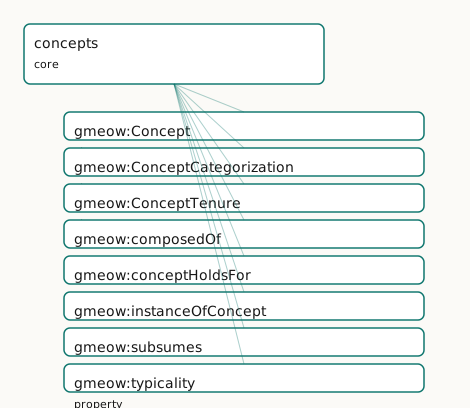
This slice owns 8 terms and contributes 3 mapping or projection rows. Use it when its terms match the native fact you want to preserve; use the linkage tables to see how those facts leave GMEOW for consumer vocabularies.
Dependencies
gmeow:slices/kernelgmeow:slices/observationsgmeow:slices/provenancegmeow:slices/standpointgmeow:slices/temporal
Consumers
- The agent-memory flagship category/spine and learning surfaces (Principle 15): an LLM output categorizes an entity under a concept or schema, recorded via the flat
gmeow:instanceOfConceptshortcut in the 80% case and promoted to a reifiedgmeow:ConceptCategorizationStandpointClaimwhen the vantage, graded typicality, temporal scope, or provenance must be first-class. Consumed by retrieval stores, knowledge-graph enrichment, and learning-module concept scaffolding.
Local Map
Examples
Conceptual Change
- Source:
slices/core/concepts/examples/conceptual-change.ttl - GMEOW terms:
gmeow:Agent,gmeow:Concept,gmeow:ConceptCategorization,gmeow:ConceptTenure,gmeow:Entity,gmeow:TimeInterval,gmeow:accordingTo,gmeow:claimModality,gmeow:conceivable,gmeow:conceptHoldsFor - External prefixes:
xsd
# SPDX-FileCopyrightText: 2026 Blackcat Informatics® Inc. <paudley@blackcatinformatics.ca>
# SPDX-License-Identifier: CC-BY-4.0
#
# Worked example — CONCEPTUAL CHANGE (, Task 2).
#
# Scenario: the concept "planet" changes its intension around the 2006 IAU  # codespell:ignore
# redefinition.  The pre-2006 intension ("a body orbiting the Sun") is recorded  # codespell:ignore
# as a closed gmeow:ConceptTenure that is suppressed with gmeow:displayable false
# (Principle 10).  The post-2006 intension ("a body that has cleared its  # codespell:ignore
# neighbourhood") is recorded as a new, open tenure.
#
# Pluto is then categorized under the concept "planet" from two coexisting
# standpoints (Principle 9): the IAU 2006 standpoint assigns a low typicality
# (it is a dwarf planet under the new intension), while a school-textbook  # codespell:ignore
# standpoint assigns a higher typicality (it is still presented as a planet in
# introductory materials).  Both categorizations coexist; neither is privileged.

@prefix gmeow: <https://blackcatinformatics.ca/gmeow/> .
@prefix ex:    <https://blackcatinformatics.ca/gmeow/examples/concepts/conceptual-change/> .
@prefix rdfs:  <http://www.w3.org/2000/01/rdf-schema#> .
@prefix xsd:   <http://www.w3.org/2001/XMLSchema#> .
@prefix skos:  <http://www.w3.org/2004/02/skos/core#> .

# --- The concept "planet" ---------------------------------------------------------
ex:planet a gmeow:Concept ;
    rdfs:label "planet"@en .

# --- Pre-2006 intension, closed and suppressed (Principle 10) ---------------------  # codespell:ignore
ex:planetTenurePre2006 a gmeow:ConceptTenure ;
    rdfs:label "pre-2006 intension of 'planet'"@en ;  # codespell:ignore
    gmeow:conceptHoldsFor ex:planet ;
    gmeow:duringInterval ex:pre2006Interval ;
    rdfs:comment "A body orbiting the Sun."@en ;
    gmeow:displayable false .

ex:pre2006Interval a gmeow:TimeInterval ;
    gmeow:startedAtTime "0001-01-01T00:00:00Z"^^xsd:dateTime ;
    gmeow:endedAtTime "2006-08-24T00:00:00Z"^^xsd:dateTime ;
    gmeow:hasTemporalFrame gmeow:temporalFrameUTCGregorian .

# --- Post-2006 intension, open tenure ---------------------------------------------  # codespell:ignore
ex:planetTenurePost2006 a gmeow:ConceptTenure ;
    rdfs:label "post-2006 intension of 'planet'"@en ;  # codespell:ignore
    gmeow:conceptHoldsFor ex:planet ;
    gmeow:duringInterval ex:post2006Interval ;
    rdfs:comment "A body that has cleared its neighbourhood."@en .

ex:post2006Interval a gmeow:TimeInterval ;
    gmeow:startedAtTime "2006-08-24T00:00:00Z"^^xsd:dateTime ;
    gmeow:hasTemporalFrame gmeow:temporalFrameUTCGregorian .

# --- The entity being categorized -------------------------------------------------
ex:pluto a gmeow:Entity ;
    rdfs:label "Pluto"@en .

# --- Standpoint: IAU 2006 — low typicality ----------------------------------------
ex:iau2006 a gmeow:Agent ;
    rdfs:label "IAU 2006 redefinition"@en .

ex:plutoCategorizationIAU a gmeow:ConceptCategorization ;
    rdfs:label "Pluto categorized as a planet from the IAU 2006 standpoint"@en ;
    gmeow:vantage ex:iau2006 ;
    gmeow:observedFeature ex:pluto ;
    gmeow:observationResult ex:planet ;
    gmeow:observationMethod gmeow:methodExpertJudgement ;
    gmeow:typicality "0.3"^^xsd:decimal ;
    gmeow:claimModality gmeow:conceivable ;
    gmeow:confidence "0.95"^^xsd:decimal .

# --- Standpoint: school textbook — higher typicality (Principle 9) ----------------
ex:schoolTextbook a gmeow:Agent ;
    rdfs:label "introductory school textbook"@en .

ex:plutoCategorizationTextbook a gmeow:ConceptCategorization ;
    rdfs:label "Pluto categorized as a planet in school textbooks"@en ;
    gmeow:vantage ex:schoolTextbook ;
    gmeow:observedFeature ex:pluto ;
    gmeow:observationResult ex:planet ;
    gmeow:observationMethod gmeow:methodExpertJudgement ;
    gmeow:typicality "0.85"^^xsd:decimal ;
    gmeow:claimModality gmeow:probable ;
    gmeow:accordingTo ex:schoolTextbook .
Terms
Classes
| Term | Label | Definition |
|---|---|---|
gmeow:Concept |
Concept | A category, schema, or abstraction held by an agent — a socially sustained cognitive representation. This is NOT the gUFO universal (which belongs to the gufo... |
gmeow:ConceptCategorization |
Concept Categorization | A standpoint-indexed claim that an entity is categorized under a concept — the reified form of gmeow:instanceOfConcept. The vantage is the agent or standpoint... |
gmeow:ConceptTenure |
Concept Tenure | The reified, time-scoped fact that a concept had a particular intension over an interval — conceptual change made first-class. When an agent community revises... |
Properties
| Term | Label | Definition |
|---|---|---|
gmeow:composedOf |
composed of | A compound concept is composed of one or more constituent concepts. Non-functional: a compound may have several decomposition schemes that coexist (Principle 9... |
gmeow:conceptHoldsFor |
concept holds for | Relates a gmeow:ConceptTenure to the gmeow:Concept whose intension it time-scopes. Functional: one tenure records the intension of exactly one concept; a conce... |
gmeow:instanceOfConcept |
instance of concept | A flat shortcut asserting that an entity is categorized under a concept — the cheap 80% surface paired with the reified gmeow:ConceptCategorization claim. Non-... |
gmeow:subsumes |
subsumes | A broader concept subsumes a narrower concept. Non-functional, not transitive at the core: a concept hierarchy may be polyhierarchical and source-specific, and... |
gmeow:typicality |
typicality | A graded degree of membership in [0,1] for a prototype-theoretic concept, attached to a reified gmeow:ConceptCategorization. Non-functional: multiple sources m... |
Linkages
- Rows: 3
- Projection profiles: -
- External vocabularies:
ontolex,skos
| Source | Kind | Profile | Predicate/Relation | Target | Evidence |
|---|---|---|---|---|---|
gmeow:Concept |
equivalence | - |
skos:relatedMatch | ontolex:LexicalConcept | gmeow-concepts.sssom.tsv; gmeow:eqConcepts002; confidence 0.6 |
gmeow:Concept |
equivalence | - |
skos:closeMatch | skos:Concept | gmeow-concepts.sssom.tsv; gmeow:eqConcepts001; confidence 0.8 |
gmeow:subsumes |
equivalence | - |
skos:closeMatch | skos:broader | gmeow-concepts.sssom.tsv; gmeow:eqConcepts003; confidence 0.7 |
Guide
concepts
Slice:
https://blackcatinformatics.ca/gmeow/slices/concepts· tier: core
GMEOW Concepts are socially sustained representational categories — the categories, schemas, and abstractions that agents hold and apply to entities. A gmeow:Concept is not the gUFO universal (which lives at the foundational-ontology meta-level); it is a representational object sustained by usage and by standpoint-indexed categorization claims. The slice is deliberately flat-first: gmeow:instanceOfConcept covers the cheap 80% case, and a reified gmeow:ConceptCategorization StandpointClaim is promoted when vantage, graded typicality, temporal scope, or provenance must be first-class (Principle 4). Categorizations are standpoint-indexed and coexist without a single winner (Principle 9), concept structure is expressed through gmeow:subsumes and gmeow:composedOf, and conceptual change is modeled as a time-scoped gmeow:ConceptTenure whose prior intensions are closed and suppressed rather than deleted (Principle 10).
Terms
The concept class, its flat and reified categorization surfaces, concept-structure relations, and the tenure pattern for conceptual change.
gmeow:Concept
A category, schema, or abstraction held by an agent — a socially sustained cognitive representation. This is not the gUFO universal; it lives in the domain of representational objects and is bound to agents through standpoint-indexed categorization claims.
gmeow:instanceOfConcept
The flat shortcut that asserts an entity is categorized under a concept. Domain gmeow:Entity, range gmeow:Concept, non-functional: an entity may instantiate many concepts and competing categorizations coexist (Principle 9). Promote to gmeow:ConceptCategorization when vantage or graded membership matters.
gmeow:ConceptCategorization
A standpoint-indexed claim that an entity falls under a concept — the reified form of gmeow:instanceOfConcept. It is a gmeow:StandpointClaim: gmeow:vantage names the categorizing standpoint, gmeow:observedFeature is the categorized entity, and gmeow:observationResult is the gmeow:Concept. Reuses gmeow:typicality, gmeow:confidence, gmeow:accordingTo, and gmeow:claimModality from sibling slices.
gmeow:typicality
A graded degree of membership in [0,1], attached to a gmeow:ConceptCategorization. This is prototype-theoretic typicality: a robin is a more typical bird than a penguin. It is solver-layer metadata, not an OWL reasoner entailment, and is distinct from gmeow:confidence (how sure the standpoint is) and gmeow:claimModality (the qualitative stance).
gmeow:subsumes
A broader/narrower relation between two gmeow:Concept individuals. Non-functional and not declared transitive at the core: concept hierarchies may be polyhierarchical and source-specific, and transitive closure is computed by the solver layer (Principle 12). The bridge to skos:broader lives in the mapping DSL, never as an OWL axiom here.
gmeow:composedOf
A compound concept is composed of one or more constituent concepts. Non-functional: a compound may have several valid decomposition schemes that coexist (Principle 9). Use for the internal structure of a concept, not for mereological parts of physical objects.
gmeow:ConceptTenure
The reified, time-scoped fact that a concept had a particular intension over an interval — conceptual change made first-class. A concept's definition, applicability, or usage may revise over time; the old intension is retained as a closed tenure suppressed with gmeow:displayable false, never deleted (Principle 10).
gmeow:conceptHoldsFor
Binds a gmeow:ConceptTenure to the gmeow:Concept whose intension it time-scopes. Functional: one tenure records exactly one concept, while a concept may have many tenures over time.
Reuse of gmeow:Determinacy / gmeow:hasDeterminacy from kernel
Concept boundaries are often vague, fuzzy, or disputed. Rather than minting new concept-specific vocabulary, this slice reuses gmeow:Determinacy and gmeow:hasDeterminacy. A gmeow:Concept or a gmeow:ConceptCategorization may declare gmeow:hasDeterminacy gmeow:determinacyVague (or fuzzy, probabilistic, disputed) to record the ontic character of its boundaries. This is orthogonal to gmeow:confidence (epistemic certainty) and to gmeow:typicality (graded membership). The fuzzy/probabilistic arithmetic lives in the solver layer (Principle 12).
Dependencies
Depends on kernel (gmeow:SocialObject, gmeow:Entity, gmeow:Determinacy, gmeow:hasDeterminacy, gmeow:displayable), observations (gmeow:StandpointClaim, gmeow:observedFeature, gmeow:observationResult), standpoint (gmeow:StandpointClaim, gmeow:vantage, gmeow:claimModality, gmeow:accordingTo), temporal (gmeow:TimeScopedRelation, gmeow:TimeInterval, gmeow:duringInterval, gmeow:startedAtTime, gmeow:endedAtTime), and provenance (gmeow:confidence).
External alignment
The concepts mapping set is authored in
slices/core/concepts/mappings/equivalences.ttl and compiled to
generated/mappings/gmeow-concepts.sssom.tsv.
All alignments are by reference (Principle 5); GMEOW never imports an external axiom.
| GMEOW term | External target(s) | Predicate | Note |
|---|---|---|---|
gmeow:Concept |
skos:Concept |
skos:closeMatch |
both are units of thought / categories in a concept scheme; GMEOW's concept is a socially sustained representational object, not the gUFO universal |
gmeow:Concept |
ontolex:LexicalConcept |
skos:relatedMatch |
bridge to the future lexicon slice: a lexical concept is a related but narrower language-bound notion |
gmeow:subsumes |
skos:broader |
skos:closeMatch |
broader/narrower direction is the same after domain inversion; the bridge is authored in the mapping DSL, not as an OWL sub-property axiom |
Conceptual-space and prototype-theoretic alignments are referenced in prose only. gmeow:typicality is inspired by Rosch prototype theory (graded category membership around a central prototype), and gmeow:subsumes / gmeow:composedOf are compatible with Gärdenfors conceptual-space accounts of similarity and conceptual structure. These are design notes, not resolvable RDF rows, so they do not appear in the SSSOM file.
Example
See slices/core/concepts/examples/conceptual-change.ttl for a worked example that models the change in the concept "planet" around the 2006 IAU redefinition, and the coexistence of competing standpoint-indexed categorizations of Pluto (Principle 9).