GMEOW Versions Module
- IRI: https://blackcatinformatics.ca/gmeow/slices/versions
- Tier: core
Group: core
What This Slice Covers
This slice owns 26 terms and contributes 1 mapping or projection rows. Use it when its terms match the native fact you want to preserve; use the linkage tables to see how those facts leave GMEOW for consumer vocabularies.
Dependencies
Consumers
- Version lineage for software, languages, creative works, and the ontology's own releases.
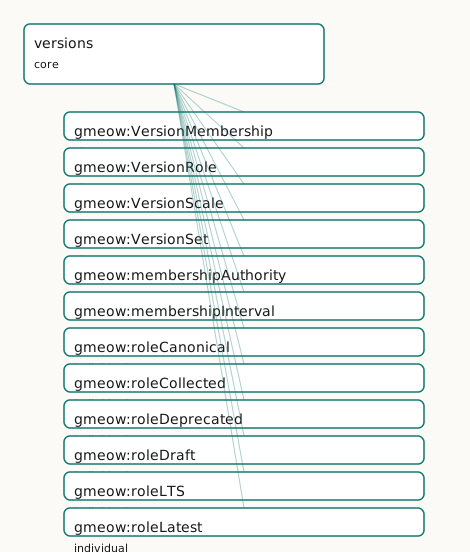
Local Map
Examples
Release Channels
- Source:
slices/core/versions/examples/release-channels.ttl - GMEOW terms:
gmeow:CreativeWork,gmeow:Instant,gmeow:Person,gmeow:TimeInterval,gmeow:VersionMembership,gmeow:VersionSet,gmeow:hasEndInstant,gmeow:hasStartInstant,gmeow:hasTemporalFrame,gmeow:inTemporalFrame - External prefixes:
xsd
# SPDX-FileCopyrightText: 2026 Blackcat Informatics® Inc. <paudley@blackcatinformatics.ca>
# SPDX-License-Identifier: CC-BY-4.0
#
# Worked example: versioning as an authority-scoped claim (Principle 10). A
# gmeow:VersionMembership is a reified Observation: it asserts that an entity
# (gmeow:versionMember) belongs to a gmeow:VersionSet with a gmeow:versionRole
# (canonical / stable / LTS / deprecated / yanked …) and a gmeow:versionScale
# (the size of the change), AS CLAIMED BY an authority (gmeow:membershipAuthority
# / gmeow:vantage). Membership is never overwritten: when a release's role
# changes (stable → deprecated), close the old membership's interval or mint a
# fresh one (P10). Here one release is canonical in the stable channel and, later,
# deprecated — both memberships coexist.
@prefix gmeow: <https://blackcatinformatics.ca/gmeow/> .
@prefix ex:    <https://blackcatinformatics.ca/gmeow/examples/versions/> .
@prefix rdfs:  <http://www.w3.org/2000/01/rdf-schema#> .
@prefix xsd:   <http://www.w3.org/2001/XMLSchema#> .

ex:maintainer a gmeow:Person ; gmeow:name "Release maintainer"@en .

ex:release100 a gmeow:CreativeWork ;
    gmeow:title              "myapp 1.0.0"@en ;
    gmeow:versionFingerprint "1.0.0" .

ex:stableChannel a gmeow:VersionSet ; rdfs:label "Stable release channel"@en .

# --- The membership claim: 1.0.0 is the canonical, major release in the stable
#     channel, as asserted by the maintainer.
ex:canonicalMembership a gmeow:VersionMembership ;
    gmeow:versionMember       ex:release100 ;
    gmeow:versionSet          ex:stableChannel ;
    gmeow:versionRole         gmeow:roleCanonical ;
    gmeow:versionScale        gmeow:scaleMajor ;
    gmeow:membershipAuthority ex:maintainer ;
    gmeow:vantage             ex:maintainer ;
    gmeow:membershipInterval  ex:canonicalPeriod .

# --- A LATER claim, not an overwrite: the same release is now deprecated. The
#     two memberships coexist; their gmeow:membershipIntervals make the order
#     machine-readable — canonical until 2026-06-01, deprecated from then on (P10).
ex:deprecatedMembership a gmeow:VersionMembership ;
    gmeow:versionMember       ex:release100 ;
    gmeow:versionSet          ex:stableChannel ;
    gmeow:versionRole         gmeow:roleDeprecated ;
    gmeow:membershipAuthority ex:maintainer ;
    gmeow:vantage             ex:maintainer ;
    gmeow:membershipInterval  ex:deprecatedPeriod .

# --- The validity periods, every value in its temporal frame (P11). The instant
#     that ends the canonical period IS the instant that begins the deprecated one.
ex:canonicalPeriod a gmeow:TimeInterval ;
    gmeow:hasStartInstant  ex:jan15 ;
    gmeow:hasEndInstant    ex:jun01 ;
    gmeow:hasTemporalFrame gmeow:temporalFrameUTCGregorian .

ex:deprecatedPeriod a gmeow:TimeInterval ;
    gmeow:hasStartInstant  ex:jun01 ;
    gmeow:hasTemporalFrame gmeow:temporalFrameUTCGregorian .

ex:jan15 a gmeow:Instant ;
    gmeow:instantValue    "2026-01-15T00:00:00Z"^^xsd:dateTime ;
    gmeow:inTemporalFrame gmeow:temporalFrameUTCGregorian .

ex:jun01 a gmeow:Instant ;
    gmeow:instantValue    "2026-06-01T00:00:00Z"^^xsd:dateTime ;
    gmeow:inTemporalFrame gmeow:temporalFrameUTCGregorian .
Terms
Classes
| Term | Label | Definition |
|---|---|---|
gmeow:VersionMembership |
Version Membership | A reified, standpoint-scoped claim that a concrete entity belongs to a version set with a particular role and/or scale — an observation in the universal claim... |
gmeow:VersionRole |
Version Role | A role or status that an entity holds within a version set according to an authority — a VALUE, never an Entity subclass. Standpoint-scoped: 'latest' according... |
gmeow:VersionScale |
Version Scale | The magnitude scale of a version change — a VALUE, never an Entity subclass. Used for SemVer-style classification and analogous schemes in non-software domains. |
gmeow:VersionSet |
Version Set | A first-class information object representing a version family or release lineage — the set of all concrete artifacts that are versions of a common stable enti... |
Properties
| Term | Label | Definition |
|---|---|---|
gmeow:membershipAuthority |
membership authority | The agent or standpoint that asserts this version membership and its role — a project maintainer, a package registry, a publisher, a curator, or a self-asserti... |
gmeow:membershipInterval |
membership interval | The time interval over which this version membership / role claim holds. A relator carries its period this way (matching gmeow:usageInterval, gmeow:taggingInte... |
gmeow:versionFingerprint |
version fingerprint | A content fingerprint of the versioned entity — a hash, SWHID, content digest, or semantic identifier. Broader than gmeow:contentDigest (which is byte-exact an... |
gmeow:versionMember |
version member | The concrete entity that participates in a version set via this membership — a software release, a book edition, an email variant, a dataset snapshot. Function... |
gmeow:versionRole |
version role | The role or status classification this membership asserts for the member within the set — canonical, variant, latest, stable, LTS, deprecated, yanked, draft, p... |
gmeow:versionScale |
version scale | The scale classification of this membership — trivial, minor, major. NON-FUNCTIONAL: different authorities or schemes may classify the same change differently;... |
gmeow:versionSet |
version set | The version set / lineage to which this membership belongs. Functional per relator: one set per VersionMembership. |
Individuals
| Term | Label | Definition |
|---|---|---|
gmeow:roleCanonical |
canonical | The canonical version role — a status that a versioned artifact occupies in its release lifecycle. |
gmeow:roleCollected |
collected | The collected version role — a status that a versioned artifact occupies in its release lifecycle. |
gmeow:roleDeprecated |
deprecated | The deprecated version role — a status that a versioned artifact occupies in its release lifecycle. |
gmeow:roleDraft |
draft | The draft version role — a status that a versioned artifact occupies in its release lifecycle. |
gmeow:roleLTS |
long-term support (LTS) | The lts version role — a status that a versioned artifact occupies in its release lifecycle. |
gmeow:roleLatest |
latest | The latest version role — a status that a versioned artifact occupies in its release lifecycle. |
gmeow:rolePublished |
published | The published version role — a status that a versioned artifact occupies in its release lifecycle. |
gmeow:roleRevised |
revised | The revised version role — a status that a versioned artifact occupies in its release lifecycle. |
gmeow:roleStable |
stable | The stable version role — a status that a versioned artifact occupies in its release lifecycle. |
gmeow:roleVariant |
variant | The variant version role — a status that a versioned artifact occupies in its release lifecycle. |
gmeow:roleWithdrawn |
withdrawn | The withdrawn version role — a status that a versioned artifact occupies in its release lifecycle. |
gmeow:roleYanked |
yanked | The yanked version role — a status that a versioned artifact occupies in its release lifecycle. |
gmeow:scaleMajor |
major | The major version scale — a magnitude category used to characterize the impact of a version change. |
gmeow:scaleMinor |
minor | The minor version scale — a magnitude category used to characterize the impact of a version change. |
gmeow:scaleTrivial |
trivial | The trivial version scale — a magnitude category used to characterize the impact of a version change. |
Linkages
- Rows: 1
- Projection profiles: -
- External vocabularies:
doap
| Source | Kind | Profile | Predicate/Relation | Target | Evidence |
|---|---|---|---|---|---|
gmeow:VersionSet |
equivalence | - |
skos:closeMatch | doap:Project | gmeow-versions.sssom.tsv; gmeow:eqVersions003; confidence 0.6 |
Guide
Versions — modelling & interoperability guide
Most vocabularies model versions as ad-hoc attributes: schema:version on a
CreativeWork, SemVer strings on a DOAP release, dcterms:isVersionOf between
dataset snapshots. Each domain reinvents its own taxonomy: StableRelease,
YankedCrate, DefinitiveEdition, CanonicalEmail.
GMEOW refuses this anti-pattern. "Latest", "stable", "yanked", "canonical",
"definitive" are not intrinsic types — they are standpoint-scoped claims
asserted by an authority (a registry, a publisher, a project, a curator). The
same artifact may be latest to npm and deprecated to a downstream mirror.
Both claims coexist without privilege (Principle 9).
Decision tree: which property to use?
| Situation | Use | Example |
|---|---|---|
| A concrete artifact belongs to a stable lineage | versionOf |
release-2.0.0 versionOf my-library |
| A concrete edition of a creative work | editionOf |
annotated-edition editionOf original-novel |
| One artifact replaces another | supersedes |
v2.0.0 supersedes v1.1.0 |
| Cross-frame correspondence without merge | counterpartOf |
robot-agent counterpartOf person |
| Derivation/provenance chain | wasDerivedFrom |
translation wasDerivedFrom original |
| Role/status within a version set (reified) | VersionMembership |
membership roleLatest accordingTo registry |
The thin spine (versionOf, editionOf, supersedes, counterpartOf) is
the 80 % flat shortcut. The reified layer (VersionMembership) is promoted
when the role claim itself must carry authority, confidence, temporal scope, or
standpoint indexing.
The reified layer: VersionMembership
A VersionMembership is an Observation + Relator in the universal claim
stack. It mediates three things:
versionMember— the concrete artifact (observedFeature)versionSet— the lineage it belongs toversionRole/versionScale— the classification, asQualityValueindividualsmembershipAuthority(vantage) — who asserts this rolemembershipInterval— when the claim holds
@prefix gmeow: <https://blackcatinformatics.ca/gmeow/> .
@prefix ex:    <https://example.org/versions/> .

ex:myLibrary a gmeow:VersionSet ;
    gmeow:name "my-library"@en .

ex:v2_0 a gmeow:SoftwareAgent ;
    gmeow:versionOf ex:myLibrary ;
    gmeow:versionLabel "2.0.0" .

ex:memLatest a gmeow:VersionMembership ;
    gmeow:versionMember ex:v2_0 ;
    gmeow:versionSet ex:myLibrary ;
    gmeow:versionRole gmeow:roleLatest ;
    gmeow:membershipAuthority ex:npmRegistry .

ex:memLTS a gmeow:VersionMembership ;
    gmeow:versionMember ex:v2_0 ;
    gmeow:versionSet ex:myLibrary ;
    gmeow:versionRole gmeow:roleLTS ;
    gmeow:membershipAuthority ex:projectMaintainer .
★ Two memberships on the same artifact, from two authorities, with two
roles — both are first-class and co-equal.
Temporal scoping: never overwrite
When a release shifts from latest to deprecated, do not overwrite the
old membership. Preserve history by either:
- Closing the interval — set an end date on
membershipInterval. - Minting a fresh membership — create a new
VersionMembershipfor the new role, leaving the old one intact.
A deprecated or yanked release may carry gmeow:displayable false so it is
suppressed from consumer projections, but it is never deleted (Principle 10).
# Old membership retained
ex:memLatest a gmeow:VersionMembership ;
    gmeow:versionMember ex:v1_1 ;
    gmeow:versionSet ex:myLibrary ;
    gmeow:versionRole gmeow:roleLatest ;
    gmeow:membershipAuthority ex:npmRegistry .

# New membership for the deprecated state
ex:memDeprecated a gmeow:VersionMembership ;
    gmeow:versionMember ex:v1_1 ;
    gmeow:versionSet ex:myLibrary ;
    gmeow:versionRole gmeow:roleDeprecated ;
    gmeow:membershipAuthority ex:npmRegistry ;
    gmeow:displayable false .
Separation from attestation layer (attestation layer)
VersionMembership records what role is asserted and by whom.
It does not embed the cryptographic or signed evidence for that assertion.
Attestation evidence — release signatures, SLSA provenance, DOI/SWHID
assertions, yanked-release notices, registry attestations — belongs in the
future attestation layer attestation layer and composes with VersionMembership by
linking evidence to the same artifacts. A version role may be attested by a
registry, but the attestation is evidence for the role claim, not the role
itself.
# version-set layer: the role claim
ex:memLatest a gmeow:VersionMembership ;
    gmeow:versionRole gmeow:roleLatest ;
    gmeow:membershipAuthority ex:npmRegistry .

# attestation layer: the attestation evidence
ex:sig a gmeow:AttestationArtifact ;
    gmeow:artifactMediaType "application/vnd.dsse+json" ;
    gmeow:hasSignature [ a gmeow:CryptographicSignature ] ;
    gmeow:wasAttributedTo ex:npmRegistry .
Value vocabularies: open, not a fence
VersionRole and VersionScale are gufo:QualityValue subclasses. The seed
list is an anchor, not a fence:
| Seed | Meaning |
|---|---|
roleCanonical |
The canonical/reference variant |
roleVariant |
A non-canonical variant |
roleLatest |
The most recent release |
roleStable |
Considered stable by the authority |
roleLTS |
Long-term support commitment |
roleDeprecated |
Discouraged but retained |
roleYanked |
Withdrawn with urgency |
roleDraft |
Unpublished / active drafting |
rolePublished |
Publicly available |
roleRevised |
A revised edition |
roleCollected |
Part of a collected volume |
roleWithdrawn |
Formally withdrawn |
scaleTrivial |
Patch-level change |
scaleMinor |
Backward-compatible change |
scaleMajor |
Breaking change |
Domain-specific values (e.g. roleNightly, roleReleaseCandidate) are minted
as fresh individuals carrying rdfs:label.
Projections
The mapping compiler generates SSSOM/EDOAL/SPARQL projections from
mapping-dsl/. Cross-vocabulary mappings include:
| GMEOW | schema.org | DOAP | Wikidata |
|---|---|---|---|
VersionSet |
— | doap:Project (lineage) |
— |
versionOf |
— | — | P548 (version type) |
versionLabel |
schema:version |
doap:revision |
— |
versionRole |
— | — | P548 qualifier |
supersedes |
— | — | P1365 (replaces) |
★ Projections are lossy by design. A "latest" selection rule lives in the
importer/solver, never as an OWL axiom (Principle 12).
Terms
gmeow:VersionSet · gmeow:versionFingerprint
A VersionSet is the stable lineage a concrete artifact belongs to — the spine
the thin flat shortcuts attach to. versionFingerprint carries a content
fingerprint of a versioned entity (hash, SWHID, content digest, or semantic
identifier); broader than the byte-exact contentDigest, and non-functional, so
one entity may carry several under different schemes.
gmeow:VersionMembership · gmeow:versionMember · gmeow:versionSet · gmeow:versionRole · gmeow:versionScale · gmeow:membershipAuthority · gmeow:membershipInterval
The reified Observation + Relator promoted when a role claim must carry
authority, confidence, temporal scope, or standpoint indexing. It mediates the
versionMember artifact, the versionSet lineage, the versionRole /
versionScale classification (as QualityValue individuals), the
membershipAuthority that asserts it (the vantage), and the membershipInterval
over which the claim holds. Two memberships on the same artifact from two
authorities are first-class and co-equal — never overwrite, mint a fresh one
(Principle 9, Principle 10).
gmeow:VersionRole · gmeow:VersionScale
The open value vocabularies (gufo:QualityValue subclasses) — a seed list, not a
fence. VersionRole ranges over roleLatest, roleStable, roleLTS,
roleDeprecated, roleYanked, roleCanonical, … ("latest"/"stable"/"yanked"
are standpoint-scoped claims, never intrinsic types); VersionScale over
scaleTrivial / scaleMinor / scaleMajor. Domain-specific values are minted as
fresh individuals carrying rdfs:label.