GMEOW Connectivity Module
- IRI: https://blackcatinformatics.ca/gmeow/slices/connectivity
- Tier: extension
Group: extensions
What This Slice Covers
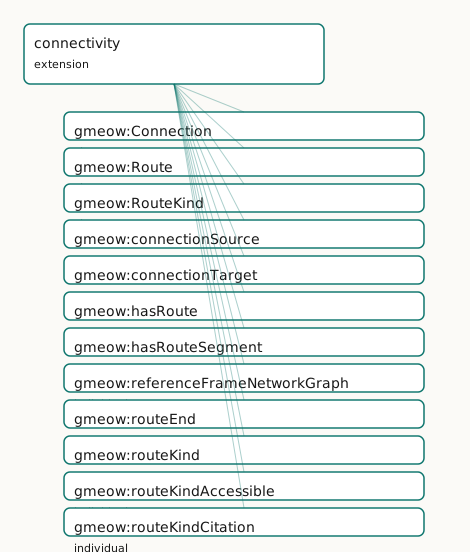
This slice owns 20 terms and contributes 3 mapping or projection rows. Use it when its terms match the native fact you want to preserve; use the linkage tables to see how those facts leave GMEOW for consumer vocabularies.
Dependencies
Consumers
- Network/route topology for places and the virtual-location realm.
Local Map
Examples
Transit Route
- Source:
slices/extensions/connectivity/examples/transit-route.ttl - GMEOW terms:
gmeow:Connection,gmeow:Place,gmeow:Route,gmeow:connectionSource,gmeow:connectionTarget,gmeow:name,gmeow:routeEnd,gmeow:routeKind,gmeow:routeKindTransit,gmeow:routeStart
# SPDX-FileCopyrightText: 2026 Blackcat Informatics® Inc. <paudley@blackcatinformatics.ca>
# SPDX-License-Identifier: CC-BY-4.0
#
# Worked example: connectivity is one graph machinery for every domain. A
# gmeow:Route runs from gmeow:routeStart through gmeow:routeVia stops to
# gmeow:routeEnd, tagged with a gmeow:routeKind — and that kind is an open
# vocabulary spanning transit, walking, flight, citation, dependency and social
# routes. So the SAME Route/Connection model describes a subway line, a paper's
# citation chain, and a package's dependency path. A gmeow:Connection is the
# single edge (source → target) the routes are built from.
@prefix gmeow: <https://blackcatinformatics.ca/gmeow/> .
@prefix ex:    <https://blackcatinformatics.ca/gmeow/examples/connectivity/> .

ex:central a gmeow:Place ; gmeow:name "Central Station"@en .
ex:midtown a gmeow:Place ; gmeow:name "Midtown"@en .
ex:airport a gmeow:Place ; gmeow:name "Airport Terminal"@en .

# --- A transit route: Central → Midtown → Airport.
ex:airportLine a gmeow:Route ;
    gmeow:routeKind  gmeow:routeKindTransit ;
    gmeow:routeStart ex:central ;
    gmeow:routeVia   ex:midtown ;
    gmeow:routeEnd   ex:airport .

# --- A single edge of the network: the Central→Midtown hop.
ex:hop a gmeow:Connection ;
    gmeow:connectionSource ex:central ;
    gmeow:connectionTarget ex:midtown .
Terms
Classes
| Term | Label | Definition |
|---|---|---|
gmeow:Connection |
Connection | A reified traversable link between two entities, able to bear its own period, cost, weight, bandwidth, confidence, and standpoint. The flat shortcut is gmeow:c... |
gmeow:Route |
Route | A traversable path through a graph of connected entities — a named, typed sequence of linked nodes with a defined start and end. Models transport lines, networ... |
gmeow:RouteKind |
Route Kind | The kind of a route — transit line, flight path, walking path, citation chain, network path, social path, dependency chain. An open value vocabulary (individua... |
Properties
| Term | Label | Definition |
|---|---|---|
gmeow:connectionSource |
connection source | The source of a reified Connection. |
gmeow:connectionTarget |
connection target | The target of a reified Connection. |
gmeow:hasRoute |
has route | Relates a thing to a route that starts from, ends at, or passes through it. |
gmeow:hasRouteSegment |
has route segment | A sub-route that is part of a larger route. A specialization of the universal gmeow:hasPart spine. |
gmeow:routeEnd |
route end | The end of a route. |
gmeow:routeKind |
route kind | The kind of a route (a RouteKind individual). |
gmeow:routeStart |
route start | The start of a route. |
gmeow:routeVia |
route via | An intermediate point that a route passes through. The order of via points is computed by the solver layer (Principle 12), not asserted in the OWL core. |
Individuals
| Term | Label | Definition |
|---|---|---|
gmeow:referenceFrameNetworkGraph |
Network Graph Reference Frame | The network graph reference frame — a named coordinate system or value space together with its axes, origin, and transformation rules (Principle 11). |
gmeow:routeKindAccessible |
accessible route | A route computed to satisfy a set of accessibility needs. The actual path is determined by the solver layer (Principle 12), not asserted in OWL. |
gmeow:routeKindCitation |
citation chain | The citation route kind — a classification of a path by the domain in which the path is traversed. |
gmeow:routeKindDependency |
dependency chain | The dependency route kind — a classification of a path by the domain in which the path is traversed. |
gmeow:routeKindFlight |
flight path | The flight route kind — a classification of a path by the domain in which the path is traversed. |
gmeow:routeKindNetwork |
network path | The network route kind — a classification of a path by the domain in which the path is traversed. |
gmeow:routeKindSocial |
social path | The social route kind — a classification of a path by the domain in which the path is traversed. |
gmeow:routeKindTransit |
transit route | The transit route kind — a classification of a path by the domain in which the path is traversed. |
gmeow:routeKindWalking |
walking route | The walking route kind — a classification of a path by the domain in which the path is traversed. |
Linkages
- Rows: 3
- Projection profiles:
schema-org - External vocabularies:
gtfs,schema
| Source | Kind | Profile | Predicate/Relation | Target | Evidence |
|---|---|---|---|---|---|
gmeow:Route |
equivalence | - |
skos:closeMatch | gtfs:Route | gmeow-connectivity.sssom.tsv; gmeow:eqConn001; confidence 0.85 |
gmeow:Route |
equivalence | - |
skos:closeMatch | schema:Trip | gmeow-connectivity.sssom.tsv; gmeow:eqConn003; confidence 0.7 |
gmeow:Route |
projection | schema-org |
projects to / <= | schema:Trip | gmeow:mapSchemaRoute; confidence 0.7; lossy: GMEOW Route is domain-generic; schema:Trip is travel-specific. RouteKind, start, end, and via metadata are dropped. |
Guide
Connectivity — traversable links, reified connections, and routes
Slice:
https://blackcatinformatics.ca/gmeow/slices/connectivity· tier: extension The universal graph layer: anything that can be traversed is said here, once.
GMEOW keeps three structural vocabularies rigorously apart: mereology (partOf — what is
made of what), RCC-8 adjacency (what touches what), and connectivity — what can be
traversed to what. This slice owns the third. The flat shortcut gmeow:connectsTo
covers the 80 % case; promote to a reified Connection when the link itself needs a
period, cost, weight, bandwidth, confidence, or standpoint (the flat-first pattern). The
constructs are deliberately universal: transit lines, network paths, citation chains,
social paths, and dependency chains are all the same machinery with a different
RouteKind value (Principle 9 — kinds are data, not subclasses). Path geometry,
ordering, and cost are computed by the solver layer (Principle 12), never asserted as
triples. The slice is part of the the design Location-as-reference-frame design.
Its Principle-15 consumer, declared in the manifest: network/route topology for places and the virtual-location realm — the graph the solver walks when it answers "how do I get from here to there", physically or virtually.
The link layer
gmeow:Connection
The reified traversable link — a gufo:Relator between two entities, able to bear its
own period, cost, weight, bandwidth, confidence, and standpoint. The flat shortcut is
gmeow:connectsTo; promote when metadata matters. Connections are admissible subjects of
the accessibility slice's AccessibilityAssertion — a barrier can live on the link,
not just the endpoint.
gmeow:connectionSource · gmeow:connectionTarget
The two functional role properties of a Connection: one source, one target per relator.
Direction is the relator's, not the vocabulary's — connectsTo itself is neither
symmetric nor transitive at the universal level, which is precisely what lets genealogy
declare hasSpouse/hasSibling (symmetric) and hasParent/hasChild (directed) as
sub-properties without leaking axioms across domains.
The route layer
gmeow:Route
A traversable path through a graph of connected entities — named, typed, with a defined
start and end. A Route is a first-class entity (it has identity: "the Number 4 line"),
but its actual path geometry, via-ordering, and cost are the solver layer's to compute
(Principle 12). The OWL core records that the route exists and what it links.
gmeow:routeStart · gmeow:routeEnd · gmeow:routeVia
Endpoints (functional) and intermediate points (non-functional, unordered). The order of via points is deliberately not asserted — sequence is a solver computation, and asserting it would freeze one traversal as schema truth.
gmeow:routeKind
Functional pointer into the RouteKind vocabulary: one kind per route.
gmeow:RouteKind
The open value vocabulary of route classifications (Principle 9): seeds
routeKindTransit, routeKindWalking, routeKindFlight, routeKindNetwork,
routeKindCitation, routeKindSocial, routeKindDependency. The breadth of the seed
list is the point — the same Route machinery serves geography, networks, scholarship,
and software.
gmeow:routeKindAccessible
The bridge value for the accessibility slice (slice-dependency doctrine refactor): a route computed to
satisfy a set of hasAccessibilityNeed facets. The value individual lives here, beside
its value class, keeping accessibility and connectivity mutually independent sibling
extensions — the vocabulary stays open (Principle 9) and neither slice imports the other.
gmeow:hasRouteSegment
Transitive sub-route composition, a specialization of the universal gmeow:hasPart
spine: a route decomposes into legs, and the reasoner derives the segment closure. This
is the one place connectivity touches mereology — a segment is a part of its route,
while the stations it links are merely connected.
gmeow:hasRoute
The convenience hook from any thing to a route that starts from, ends at, or passes through it — the entry point for "what lines serve this station" queries.
The frame seed (Principle 11)
gmeow:referenceFrameNetworkGraph
A seeded ReferenceFrame (connectivity spine): virtual realm, one scalar axis, crisp determinacy,
metric metricGraphHops. Network distance is frame-relative like every other value —
"3 hops" names its frame just as "3 km" names a spatial one. Virtual locations measure
their distances here.
Solver layer & alignment
Everything quantitative is deferred to the solver (Principle 12): shortest path, via ordering, cost accumulation, accessible-route satisfaction, reachability closure. The OWL core models the graph; the solver traverses it. Alignment is deferred — transport and network standards (GTFS, schema.org trip vocabulary) are projection targets once the consumer demands them, not pre-paid imports.
Dependencies
Depends on kernel and places. Depended on by genealogy (kinship bonds are
connectsTo sub-properties) and consumed by the accessibility solver path.