GMEOW Mentation Module
- IRI: https://blackcatinformatics.ca/gmeow/slices/mentation
- Tier: core
Group: core
What This Slice Covers
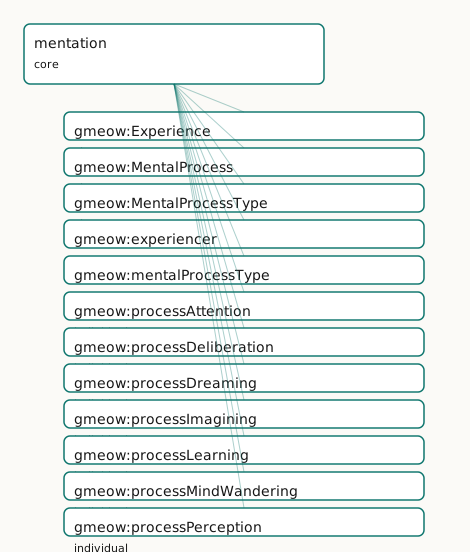
This slice owns 14 terms and contributes 1 mapping or projection rows. Use it when its terms match the native fact you want to preserve; use the linkage tables to see how those facts leave GMEOW for consumer vocabularies.
Dependencies
Consumers
- The agent-memory timeline — a unified, queryable record of an agent's mental life as it unfolds; the single occurrent substrate that inference, learning, imagination, and dreaming specialise or compose over.
Local Map
Examples
Mental Timeline
- Source:
slices/core/mentation/examples/mental-timeline.ttl - GMEOW terms:
gmeow:Agent,gmeow:Event,gmeow:Experience,gmeow:MentalMoment,gmeow:MentalProcess,gmeow:eventTemporalFrame,gmeow:eventTime,gmeow:experiencer,gmeow:mentalProcessType,gmeow:name - External prefixes:
xsd
# SPDX-FileCopyrightText: 2026 Blackcat Informatics® Inc. <paudley@blackcatinformatics.ca>
# SPDX-License-Identifier: CC-BY-4.0
#
# Worked example — a small mental timeline for one agent.
#
# Three mental occurrents illustrate the mentation slice's core idioms:
#   1. A gmeow:MentalProcess of type processPerception — Ada notices morning light.
#      Carries a temporal frame the same way gmeow:Event takes one (events idiom,
#      gmeow:eventTime + gmeow:eventTemporalFrame), and links back to a perceptual
#      claim via gmeow:realizesMoment (open-range bridge).
#   2. A gmeow:MentalProcess of type processReasoning — Ada works through a proof.
#      gmeow:realizesMoment points at ex:beliefQEDholds, a placeholder node that will
#      be typed gmeow:MentalMoment once slice kernel/cognition  lands; open-range
#      at this tier is deliberate and documented in the slice.
#   3. A gmeow:Experience (the phenomenal subset of MentalProcess) of type
#      processDreaming — Ada's dream last night. gmeow:Experience is used because
#      there is something it is like to undergo a dream (the qualia-bearing subset).
#
# All three are borne by exactly one experiencer (gmeow:experiencer is functional);
# gmeow:mentalProcessType is non-functional, so a process can carry multiple types.

@prefix gmeow: <https://blackcatinformatics.ca/gmeow/> .
@prefix ex:    <https://blackcatinformatics.ca/gmeow/examples/mentation/> .
@prefix rdfs:  <http://www.w3.org/2000/01/rdf-schema#> .
@prefix xsd:   <http://www.w3.org/2001/XMLSchema#> .

# --------------------------------------------------------------------------- #
# Agent
# --------------------------------------------------------------------------- #

ex:ada a gmeow:Agent ;
    gmeow:name "Ada"@en .

# --------------------------------------------------------------------------- #
# 1. Morning perception — a MentalProcess of type processPerception
# --------------------------------------------------------------------------- #

ex:morningPerception a gmeow:MentalProcess ;
    rdfs:label "Ada's morning perception of daylight"@en ;
    gmeow:experiencer ex:ada ;                            # functional: one process, one experiencer
    gmeow:mentalProcessType gmeow:processPerception ;     # value-vocab slot, not a subclass
    gmeow:eventTime "2026-06-15T07:12:00Z"^^xsd:dateTime ; # temporal frame — same idiom as events/wedding.ttl
    gmeow:eventTemporalFrame gmeow:temporalFrameUTCGregorian ;
    gmeow:realizesMoment ex:perceivedMorningLight .       # open-range: the perceptual claim produced

# The open-range target — will be gmeow:MentalMoment once  lands.
ex:perceivedMorningLight
    rdfs:label "Ada's perceptual state: morning light perceived"@en .

# --------------------------------------------------------------------------- #
# 2. Proving a theorem — a MentalProcess of type processReasoning
# --------------------------------------------------------------------------- #

ex:solvingTheProof a gmeow:MentalProcess ;
    rdfs:label "Ada's reasoning through the proof of QED"@en ;
    gmeow:experiencer ex:ada ;
    gmeow:mentalProcessType gmeow:processReasoning ;      # an inference episode unfolding in time
    gmeow:eventTime "2026-06-15T09:30:00Z"^^xsd:dateTime ;
    gmeow:eventTemporalFrame gmeow:temporalFrameUTCGregorian ;
    gmeow:realizesMoment ex:beliefQEDholds .              # the resulting belief — open range

# Placeholder target: open-range means any mode/claim/state is acceptable here.
# Once gmeow:MentalMoment (kernel/cognition ) lands this will be typed properly.
ex:beliefQEDholds
    rdfs:label "belief: the proof concludes (QED)"@en .

# --------------------------------------------------------------------------- #
# 3. Last night's dream — a gmeow:Experience (the phenomenal subset)
# --------------------------------------------------------------------------- #

ex:lastNightsDream a gmeow:Experience ;                   # qualia-bearing: there is something it is like
    rdfs:label "Ada's dream last night"@en ;
    gmeow:experiencer ex:ada ;
    gmeow:mentalProcessType gmeow:processDreaming ;       # offline, sleep-bound imagined content
    gmeow:eventTime "2026-06-15T03:00:00Z"^^xsd:dateTime ;
    gmeow:eventTemporalFrame gmeow:temporalFrameUTCGregorian .
    # No gmeow:realizesMoment: a dream need not update a belief state;
    # gmeow:realizesMoment is non-functional so its absence is valid.
Terms
Classes
| Term | Label | Definition |
|---|---|---|
gmeow:Experience |
Experience | The phenomenally-conscious, qualia-bearing subset of gmeow:MentalProcess — a mental occurrence there is something it is like to undergo: a perception-as-experi... |
gmeow:MentalProcess |
Mental Process | A mental occurrence that unfolds in time — the perdurant (occurrent) counterpart of the endurant gmeow:MentalMoment: a perceiving, a reasoning, an imagining, a... |
gmeow:MentalProcessType |
Mental Process Type | The kind of a mental process — a closed-but-open value vocabulary (individuals, never subclasses; the gmeow:EventType idiom): gmeow:processPerception, gmeow:pr... |
Properties
| Term | Label | Definition |
|---|---|---|
gmeow:experiencer |
experiencer | The agent whose mental process this is — the one undergoing the perceiving, reasoning, or dreaming. Functional: one process, one experiencer (a mental occurren... |
gmeow:mentalProcessType |
mental process type | The kind of a mental process — a gmeow:MentalProcessType value (gmeow:processPerception, gmeow:processReasoning, gmeow:processDreaming, …). NOT functional: a s... |
gmeow:realizesMoment |
realizes moment | Relates a mental process to a mental moment it produces or updates — the occurrent-to-endurant bridge across the gUFO endurant/occurrent divide: a reasoning re... |
Individuals
| Term | Label | Definition |
|---|---|---|
gmeow:processAttention |
attention | An episode of selective attention — focusing cognitive resources on a subject, sensation, or task while backgrounding the rest. |
gmeow:processDeliberation |
deliberation | A deliberation episode — practical weighing of options, reasons, or consequences toward a choice or intention. |
gmeow:processDreaming |
dreaming | A dreaming episode — an offline, typically sleep-bound gmeow:Experience of imagined content; composed into the dreaming extension with awareness mode an... |
gmeow:processImagining |
imagining | An episode of imagining — entertaining quasi-perceptual or suppositional content as-if, decoupled from current perception and from belief (the imagination slic... |
gmeow:processMindWandering |
mind-wandering | A mind-wandering episode — undirected, stimulus-independent thought that drifts without a task goal (daydreaming, spontaneous reverie). |
gmeow:processPerception |
perception | A perceptual episode — sensing and registering the environment (or an internal state) as it occurs. The occurrent that typically realizes a perceptual observat... |
gmeow:processReasoning |
reasoning | A reasoning episode — inference as it unfolds in time, drawing a conclusion from premises. The occurrent face of a gmeow:InferenceProcess (inference slice). |
gmeow:processRecollection |
recollection | A recollection episode — retrieving a stored memory into present awareness (the act, not the stored content). Forgetting is modelled as suppression elsewhere,... |
Linkages
- Rows: 1
- Projection profiles: -
- External vocabularies:
bfo
| Source | Kind | Profile | Predicate/Relation | Target | Evidence |
|---|---|---|---|---|---|
gmeow:MentalProcess |
equivalence | - |
skos:relatedMatch | bfo:BFO_0000015 | gmeow-mentation.sssom.tsv; gmeow:eqMentation001; confidence 0.5 |
Guide
mentation
Slice:
https://blackcatinformatics.ca/gmeow/slices/mentation· tier: core
The occurrent (perdurant) half of mind — mental processes and experiences that unfold in time: perceiving, reasoning, imagining, remembering, dreaming. The companion to the endurant mental-moment stack (belief, knowledge, desire, emotion) in the cognition / epistemics family. Where the endurant slices model the states an agent is in, this slice models the events that produce or update them.
In gUFO's ontological split, endurants are continuants that persist through time (modes, qualities,
states — gmeow:MentalMoment and its subclasses), while perdurants (occurrents) are processes and
experiences that have temporal parts and unfold by happening. GMEOW's endurant mental side is rich;
this slice completes the picture with the perdurant umbrella so the full arc — from process to
resulting state — can be queried as a single timeline.
Classes
gmeow:MentalProcess
A mental occurrence that unfolds in time — the perdurant (occurrent) counterpart of the endurant
gmeow:MentalMoment: a perceiving, a reasoning, an imagining, a remembering, a dreaming. The
kernel-level umbrella under which every mental event lives, so an agent's mental life can be queried
as a single occurrent stream. A gmeow:Event borne by exactly one agent (gmeow:experiencer); the
kind of process is a gmeow:mentalProcessType value, never a subclass (Principle 9).
gmeow:InferenceProcess (inference slice) and gmeow:LearningEvent (learning slice) reparent
under it from their own slices.
Stereotype: owl:Class, gufo:EventType · ⊑ gmeow:Event
gmeow:Experience
The phenomenally-conscious, qualia-bearing subset of gmeow:MentalProcess — a mental occurrence
there is something it is like to undergo: a perception-as-experienced, a felt emotion-episode, a
dream. Distinguished from sub-personal mental processing that carries no first-person character. The
one genuine subclass in this slice; finer kinds remain gmeow:mentalProcessType values.
Stereotype: owl:Class, gufo:EventType · ⊑ gmeow:MentalProcess
gmeow:MentalProcessType
The kind of a mental process — a closed-but-open value vocabulary (individuals, never subclasses;
the gmeow:EventType idiom): gmeow:processPerception, gmeow:processAttention,
gmeow:processReasoning, gmeow:processImagining, gmeow:processDeliberation,
gmeow:processRecollection, gmeow:processMindWandering, gmeow:processDreaming. New kinds are
minted as individuals, never as subclasses of gmeow:MentalProcess (Principle 9: no overtyping).
Stereotype: owl:Class, gufo:AbstractIndividualType · ⊑ gufo:QualityValue
Properties
gmeow:experiencer
The agent whose mental process this is — the one undergoing the perceiving, reasoning, or dreaming. Functional: one process, one experiencer (a mental occurrent inheres in exactly one agent; two agents reasoning about the same thing are two processes).
Domain: gmeow:MentalProcess · Range: gmeow:Agent · Functional
gmeow:mentalProcessType
The kind of a mental process — a gmeow:MentalProcessType value (gmeow:processPerception,
gmeow:processReasoning, gmeow:processDreaming, …). NOT functional: a single occurrence may
carry several type values (a reverie that is both imagining and mind-wandering). Mirrors
gmeow:eventType.
Domain: gmeow:MentalProcess · Range: gmeow:MentalProcessType · Non-functional
gmeow:realizesMoment
Relates a mental process to a mental moment it produces or updates — the occurrent-to-endurant
bridge across the gUFO endurant/occurrent divide: a reasoning realizes a belief, a perceiving
realizes a perceptual claim. NOT functional — one process may settle several moments. Range is
intentionally open at this tier (the doxastic-spine precedent): it will point at a
gmeow:MentalMoment once the endurant umbrella lands with kernel/cognition; until then it may
point at any reified mode, belief-state, or claim the process produces. Renamed from the design's
realizes to avoid colliding with the WEMI gmeow:realizes (Expression → Work) — Principle 4.
Domain: gmeow:MentalProcess · Range: open (intentionally no rdfs:range) · Non-functional
Value individuals — gmeow:MentalProcessType
gmeow:processPerception
A perceptual episode — sensing and registering the environment (or an internal state) as it occurs. The occurrent that typically realizes a perceptual observation or claim.
gmeow:processAttention
An episode of selective attention — focusing cognitive resources on a subject, sensation, or task while backgrounding the rest.
gmeow:processReasoning
A reasoning episode — inference as it unfolds in time, drawing a conclusion from premises. The
occurrent face of a gmeow:InferenceProcess (inference slice).
gmeow:processImagining
An episode of imagining — entertaining quasi-perceptual or suppositional content as-if, decoupled from current perception and from belief (the imagination slice's faculty in action).
gmeow:processDeliberation
A deliberation episode — practical weighing of options, reasons, or consequences toward a choice or intention.
gmeow:processRecollection
A recollection episode — retrieving a stored memory into present awareness (the act, not the stored content). Forgetting is modelled as suppression elsewhere, not as a process here.
gmeow:processMindWandering
A mind-wandering episode — undirected, stimulus-independent thought that drifts without a task goal (daydreaming, spontaneous reverie).
gmeow:processDreaming
A dreaming episode — an offline, typically sleep-bound gmeow:Experience of imagined content;
composed into the dreaming extension with awareness mode and content-origin.
Doctrine highlights
- Occurrent umbrella —
gmeow:MentalProcess⊑gmeow:Eventis the single home for every mental occurrence; one SPARQL query returns an agent's whole mental timeline. - Value-vocab, not taxonomy (Principle 9) — the kind of a process is a
gmeow:mentalProcessTypevalue (agmeow:MentalProcessTypeindividual), never a subclass ofgmeow:MentalProcess. The one genuine subclass isgmeow:Experience— the phenomenally-conscious subset. - Open-range bridge —
gmeow:realizesMomenthas nordfs:rangeat this tier (the doxastic-spine precedent). It will range overgmeow:MentalMomentonce the endurant umbrella lands with kernel/cognition; until then it points at any mode, belief-state, or claim the process produces. - Renamed from
realizes(Principle 4) — the design usedrealizes; renamed torealizesMomentto avoid colliding with the WEMIgmeow:realizes(Expression→Work) in the creative-works slice. - Reparenting hooks stay open —
gmeow:InferenceProcessandgmeow:LearningEventdeclarerdfs:subClassOf gmeow:MentalProcessfrom their own slices, never pre-declared here.
Dependencies
Depends on kernel (gmeow:Agent, gmeow:Event via events), events (the event spine and
gufo:EventType stereotype), temporal, and observations.